Offshore Crane Accidents: Your Legal Rights and Who to Sue
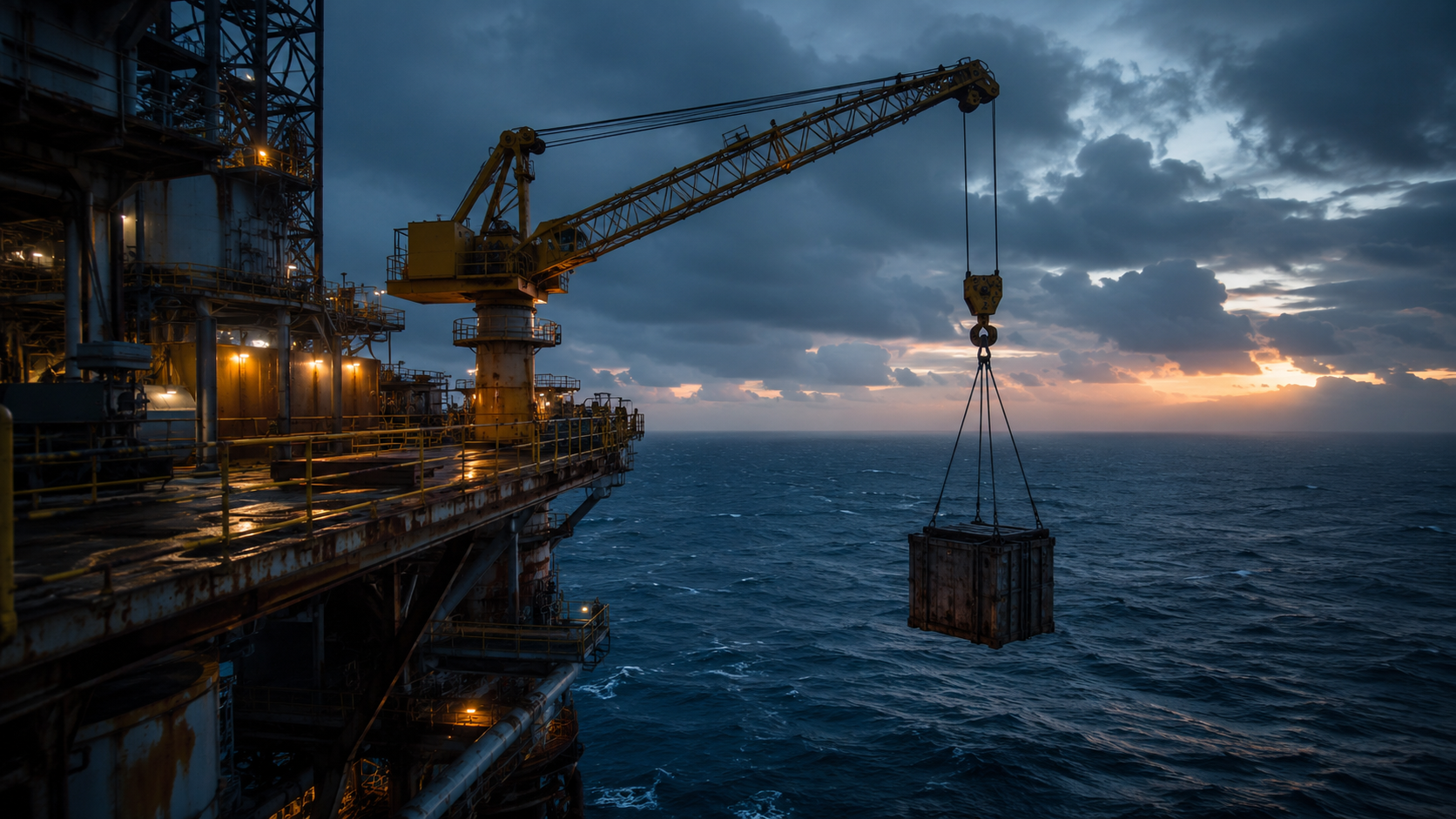
On an offshore rig, a crane is never off. It swings drill pipe, supply baskets, and multi-ton loads over the heads of the crew, hour after hour, in wind and swell. When a line parts, a load drops, or a boom swings the wrong way, the worker underneath rarely gets a second chance.
IN SHORT
After offshore crane accidents, an injured seaman can sue the employer under the Jones Act and the vessel owner for an unseaworthy crane, while a non-seaman platform worker can pursue a Section 905(b) vessel-negligence claim plus third-party suits against the crane manufacturer or service contractor. Most claims must be filed within three years.
This article is for informational purposes only and does not constitute legal advice. Liability after a crane accident depends on your worker status and the specific facts, and deadlines apply. To understand your own rights, consult a licensed maritime attorney.
Key Facts at a Glance
- Being struck by an object is one of OSHA’s “Fatal Four” hazards, and OSHA estimates about 75% of struck-by fatalities involve heavy equipment such as trucks or cranes.
- The Jones Act, 46 U.S.C. § 30104, lets an injured seaman sue an employer whose negligence played even the slightest part in a crane accident.
- A defective crane, frayed cable, or worn sling can make a vessel unseaworthy, a strict-liability claim that needs no proof of carelessness.
- A platform worker who is not a seaman can sue the vessel owner for negligence under Section 905(b) of the LHWCA, governed by the three Scindia duties.
- Crane and lifting operations on the Outer Continental Shelf are regulated by the Bureau of Safety and Environmental Enforcement (BSEE).
- Offshore crane cases often have multiple defendants: the employer, the vessel or rig owner, the crane manufacturer, and crane-service or rigging contractors.
- Most maritime injury claims must be filed within three years under 46 U.S.C. § 30106, though some platform deadlines are shorter.
Offshore cranes lift the loads that keep a rig running, and they do it in the worst possible conditions: a moving deck, gusting wind, heavy seas, and crews working directly below. A single mechanical failure or rigging mistake turns a routine lift into a catastrophe. The worker who is struck, crushed, or knocked from height can face a brain injury, a shattered spine, an amputation, or death.
These cases are also legally distinctive. The amount you can recover, and who you can recover it from, depends first on whether you are a seaman or a land-based maritime worker, and then on how many companies had a hand in the lift. This guide walks through how offshore crane accidents happen, who is liable under each scenario, what the claim is worth, and the deadlines that can quietly end it.
A crane accident can involve several companies and a short window to act. Find out who is responsible and what your claim is worth, at no cost.
How Do Crane Accidents Happen Offshore?
Most offshore crane accidents trace to one of a handful of failures: a dropped or swinging load, a structural or mechanical failure of the crane itself, a rigging failure, or operator and communication error. Each is preventable, and each typically points to negligence, an unseaworthy condition, or a defective product.
| Mechanism | What happens | Common root cause |
|---|---|---|
| Dropped load | A load falls from the hook or rigging and strikes workers below | Frayed or overloaded cable, failed sling or shackle, improper rigging |
| Swinging load | Wind or sudden movement swings the load into a worker | Lifting in unsafe sea state, no tag line, poor signaling |
| Crane or boom failure | The boom buckles or the crane collapses | Skipped inspection, metal fatigue, overload beyond the rated capacity |
| Caught or crushed | A worker is pinned between the load, the crane, and a fixed structure | Blind lifts, inadequate exclusion zone, undermanning |
| Fall from the crane | Operator or rigger falls from the cab, boom, or pedestal | Missing guarding, no fall protection, defective access ladder |
Mechanisms compiled from OSHA struck-by hazard analysis (OSHA) and reported offshore crane incidents.
The physics are unforgiving. OSHA’s struck-by guidance illustrates that even a small object dropped from height can be lethal; an offshore crane routinely moves loads of thousands of pounds dozens of feet above the deck. There is no safe way to be under a failing lift.
What Injuries Do Offshore Crane Accidents Cause?
Crane accidents produce the most severe injuries in the maritime workplace because they combine great force with great height. A worker struck by a load or knocked to a lower deck commonly suffers a traumatic brain injury, spinal fractures, crushed or amputated limbs, or fatal trauma.
These are the catastrophic, career-ending injuries: a struck-by head impact that causes lasting cognitive damage, a fall that fractures vertebrae and damages the spinal cord, a hand or arm crushed between a load and a railing. For the injury-specific picture, see our guides to maritime back and spinal injuries and offshore burn injuries when a lift strikes equipment or a fuel line. Because the harm is usually permanent, the value of a crane case turns on lifetime care and lost earning capacity, not just immediate medical bills.
Are You a Seaman or a Longshoreman? Why It Decides Your Crane Claim
This is the first and most important question in any offshore crane case, because it controls which law applies and how much you can recover. A seaman has the powerful Jones Act and unseaworthiness remedies; a non-seaman is generally limited to LHWCA benefits plus third-party suits. Crane operators and riggers fall on both sides of the line depending on their connection to a vessel.
| Worker | Usual status | Primary remedy | Recovers pain and suffering from employer? |
|---|---|---|---|
| Crane operator or deckhand on a vessel or MODU | Seaman | Jones Act + unseaworthiness + maintenance and cure | Yes (full tort damages) |
| Rigger or roustabout assigned to a vessel crew | Often a seaman | Jones Act + unseaworthiness | Yes |
| Worker on a fixed platform on the shelf | LHWCA via OCSLA | LHWCA benefits + Section 905(b) third-party suit | No from employer; yes from a negligent vessel/third party |
| Longshore/loading worker, not a seaman | LHWCA | LHWCA benefits + Section 905(b) vs vessel | No from employer; yes from the vessel |
Seaman status is decided under Chandris, Inc. v. Latsis, 515 U.S. 347 (1995) (roughly a 30% connection to a vessel in navigation). Fixed-platform work is governed by OCSLA, 43 U.S.C. ch. 29.
Whether you spend enough time in service of a vessel to be a seaman can change a crane case by hundreds of thousands of dollars. If a mobile drilling unit, lift boat, or supply vessel was involved, your status is worth contesting, and our guide on whether you qualify as a Jones Act seaman explains the test.
How Can an Injured Seaman Recover After a Crane Accident?
A seaman injured in a crane accident usually has three overlapping claims and should pursue all of them: Jones Act negligence, unseaworthiness, and maintenance and cure. Together they cover fault-based damages, a strict-liability theory, and no-fault medical and living support.
Under the Jones Act, the burden is the relaxed “featherweight” causation standard: the employer is liable if its negligence played any part, even the slightest, in the injury, a standard set in Rogers v. Missouri Pacific R.R. (1957) and applied in Gautreaux v. Scurlock Marine (5th Cir. 1997) and CSX Transportation v. McBride (2011). Independently, a defective crane, a frayed cable, or an incompetent crane crew can make the vessel unseaworthy, which is strict liability and requires no proof of negligence at all. And from the moment of injury, the seaman is owed maintenance and cure until maximum medical improvement, regardless of fault; an employer who refuses can face punitive damages under Atlantic Sounding Co. v. Townsend (2009).
A frayed lifting cable can win a crane case two ways at once: as evidence the employer was negligent under the Jones Act, and as proof the vessel was unseaworthy, a strict-liability theory that does not require showing anyone was careless.
Worked example. A deckhand is struck when a 500-pound load drops because the lifting line parted. Reported maritime results show how serious these are; one offshore worker struck on the head by a load hoisted by a crane, after the line broke, pursued a Jones Act claim for his brain and back injuries (Source: Zehl & Associates). The same parted line supports a negligence theory (failure to inspect and replace) and an unseaworthiness theory (gear not fit for its purpose), and the crew’s account of the lift is preserved evidence for both.
A crane accident can involve several companies and a short window to act. Find out who is responsible and what your claim is worth, at no cost.
Can a Longshoreman Sue the Vessel Owner Under Section 905(b)?
Yes. A maritime worker who is covered by the LHWCA rather than the Jones Act cannot sue the employer for negligence, but Section 905(b) preserves a separate negligence lawsuit against the vessel owner. For a non-seaman hurt by a vessel’s crane, this is often the only route to full damages, including pain and suffering.
The vessel owner’s duties are narrower than ordinary negligence. In Scindia Steam Navigation Co. v. De Los Santos, 451 U.S. 156 (1981), the Supreme Court defined three duties a vessel owes a longshore worker, and a crane accident can breach any of them:
- Turnover duty. The vessel must be turned over with its equipment, including a ship’s crane, in a condition that lets a competent contractor work safely, and the owner must warn of hidden defects it knew or should have known about.
- Active control duty. Once work begins, the vessel must use reasonable care to prevent injury in areas, or over equipment, that remain under its active control, such as a crane operated by the vessel’s own crew.
- Duty to intervene. If the vessel learns that the contractor is using gear in an obviously dangerous way, or that the ship’s equipment is failing, it must act.
So a longshore worker crushed by a load lifted with the ship’s defective crane, operated by the vessel’s crew, may have a strong active-control or turnover claim against the vessel owner even though the employer is immune. Our dedicated guide to Section 905(b) vessel-negligence claims covers how these duties are proven.
Worked example. A rigging contractor’s employee is struck when a sling fails during a lift run by the vessel’s crew using the ship’s pedestal crane. He collects LHWCA benefits from his own employer (no-fault), and separately sues the vessel owner under Section 905(b), arguing the crane and its rigging were under the vessel’s active control and were not reasonably safe. The two claims proceed together, subject to the carrier’s lien.
Who Else Can Be Sued After an Offshore Crane Accident?
Offshore crane accidents rarely involve a single company. A modern lift can involve the employer, the rig or vessel owner, the crane manufacturer, a crane-maintenance or inspection contractor, and a rigging company, and maritime law often lets you sue several at once. Identifying every responsible party is what separates a full recovery from a partial one, especially for LHWCA workers whose only path to pain-and-suffering damages runs through third parties.
| Potential defendant | Legal theory | When it applies |
|---|---|---|
| Employer (if you are a seaman) | Jones Act negligence | Unsafe lift plan, undermanning, poor training, defective gear it controlled |
| Vessel or rig owner | Unseaworthiness (seamen) or Section 905(b) (longshore) | Defective crane, cable, or crew that was part of the vessel |
| Crane manufacturer | Product liability (design, manufacturing, or warning defect) | A boom, hoist, or control failed because it was defectively designed or built |
| Crane service / inspection contractor | Third-party negligence | Negligent maintenance, repair, or certification of the crane |
| Rigging or lifting contractor | Third-party negligence | Defective sling/shackle, improper rigging, or an unsafe lift plan |
Maritime law permits suing multiple non-employer defendants; for LHWCA workers the third-party suit is often the only route to full common-law damages. See our overview of third-party offshore injury claims.
Why the defendant list matters most for platform workers. If you are an LHWCA-covered platform worker, your employer pays no-fault benefits but is immune from suit. The crane manufacturer, the inspection contractor, and the vessel owner are not. Missing one of them can leave most of your damages on the table.
What Safety Rules Govern Offshore Cranes?
Offshore cranes are heavily regulated, and a documented violation is powerful evidence of negligence. On the Outer Continental Shelf, the Bureau of Safety and Environmental Enforcement (BSEE) regulates crane and lifting operations and incorporates recognized offshore crane standards, while OSHA and the U.S. Coast Guard set additional requirements depending on the structure and the work.
These rules cover crane inspection and certification, load charts and rated capacity, operator qualification, and rigging gear. When an employer or contractor skips an inspection, exceeds the rated capacity, or uses uncertified rigging, that violation does more than break a rule: under maritime law it can shift the burden and help establish that the violation caused the injury. The federal data underscores why the rules exist; struck-by incidents are a leading cause of work fatalities, and the Bureau of Labor Statistics tracks the water transportation sector among the more dangerous U.S. industries (Source: U.S. Bureau of Labor Statistics).
How Much Is an Offshore Crane Accident Claim Worth?
There is no single figure. A crane accident claim is worth the full economic and human cost of the injury, which depends on its severity, the strength of the liability proof, the number of solvent defendants, and your lost earning capacity. Because crane injuries are usually catastrophic, these cases sit at the high end of maritime claim values, but any site quoting a fixed “average” is selling false certainty.
What can be said is that the value is built from the same components in every serious case: past and future medical care and rehabilitation, past and future lost wages, lost earning capacity when the worker cannot return to offshore work, pain and suffering, and the toll on the worker’s family. The presence of multiple defendants, an employer, a vessel owner, a crane manufacturer, can also increase the pressure to settle, because each wants to avoid a large joint verdict. For how maritime damages are assembled, see our guide to offshore oil rig injury compensation.
Do not settle before the evidence is preserved. Crane cases live and die on the physical evidence: the failed cable, the load chart, the inspection records, the maintenance logs. Once the deck is cleared and the gear is repaired, the proof is gone. Quick settlement offers are designed to close the case before that evidence is examined.
How Long Do You Have to File an Offshore Crane Accident Claim?
In most cases, three years from the date of injury, but the deadline depends on your worker status, and some are much shorter. The table below shows the common windows.
| Worker / claim type | Typical deadline | Authority / note |
|---|---|---|
| Seaman (Jones Act and unseaworthiness) | 3 years from injury | 46 U.S.C. § 30106 |
| LHWCA worker (benefits) | Notice ~30 days; claim ~1 year | Shorter notice windows; see DOL OWCP |
| Section 905(b) suit vs vessel | Generally 3 years | Federal maritime tort period |
| OCSLA platform worker (third-party) | Often the adjacent state’s deadline | 43 U.S.C. ch. 29; can be as short as 1 year |
| Wrongful death beyond 3 nm (DOHSA) | 3 years from death | 46 U.S.C. ch. 303 |
Deadlines vary by status and jurisdiction; three years is a default, not a guarantee. See our full guide to the maritime statute of limitations.
With multiple defendants, the clock can run differently against each one, and a platform worker’s state-law third-party deadline may be the shortest of all. Do not assume you have years.
A crane accident can involve several companies and a short window to act. Find out who is responsible and what your claim is worth, at no cost.
What Should You Do After an Offshore Crane Accident?
The steps you take in the first hours protect both your health and your claim, and in a crane case the evidence disappears fast.
- Get medical care and report the accident. Insist on a documented evaluation, and describe every symptom, including head, neck, and back complaints that can signal a serious injury.
- Demand that the gear be preserved. The failed cable, sling, shackle, hook, and the crane itself should not be repaired, discarded, or returned to service before they are inspected. Ask in writing.
- Identify the load chart and the lift plan. Whether the load exceeded the rated capacity, and who planned the lift, are central facts. So are the crane’s inspection and maintenance records.
- Get the names of every company on the job. The crane owner, the operator’s employer, the rigging contractor, and the inspection company may all be separate defendants.
- Do not give a recorded statement or sign a release. These are designed to limit your claim before liability is investigated.
- Talk to a maritime attorney before the deadline runs. Status determinations, multi-defendant liability, and evidence preservation all need to start early.
If a crane accident was fatal, the worker’s family may have a wrongful-death claim under the Jones Act or DOHSA depending on where the death occurred, and those claims carry their own deadlines.
Frequently Asked Questions
Can you sue for an offshore crane accident?
Yes. If you are a seaman, you can sue your employer under the Jones Act and the vessel owner for an unseaworthy crane. If you are a non-seaman platform or longshore worker, you can pursue LHWCA benefits plus a Section 905(b) negligence suit against the vessel owner and third-party suits against the crane manufacturer or service contractor. A free case review can confirm which path fits.
Who is liable for a dropped load or crane failure offshore?
It can be several parties at once: the employer (if you are a seaman), the vessel or rig owner (for an unseaworthy or negligently controlled crane), the crane manufacturer (for a defective product), and the crane-service or rigging contractor (for negligent maintenance or rigging). Maritime law often allows suing multiple defendants in the same case.
What is the difference between a Jones Act and a Section 905(b) crane claim?
A Jones Act claim is available to seamen and is brought against the employer under a relaxed featherweight negligence standard. A Section 905(b) claim is available to LHWCA-covered non-seamen and is brought against the vessel owner, limited to the three Scindia duties (turnover, active control, and intervene). Your worker status determines which applies.
How much is an offshore crane accident settlement worth?
It depends on the severity of the injury, the strength of the liability evidence, the number of solvent defendants, and your lost earning capacity, so there is no reliable average. Crane injuries are typically catastrophic, which places these cases at the high end of maritime claim values, but each case turns on its own facts.
What injuries are most common in offshore crane accidents?
Struck-by and crush mechanisms produce the most severe maritime injuries: traumatic brain injuries, spinal fractures and spinal cord damage, crushed or amputated limbs, and fatal trauma. Because the harm is usually permanent, lifetime care and lost earning capacity drive the value of the claim.
How long do I have to file an offshore crane accident claim?
Usually three years from the date of injury under 46 U.S.C. § 30106 for Jones Act, unseaworthiness, and Section 905(b) claims. LHWCA benefit deadlines and OCSLA platform third-party deadlines can be much shorter, sometimes a year or less, so do not wait.
What safety rules apply to offshore cranes?
Crane and lifting operations on the Outer Continental Shelf are regulated by BSEE, which incorporates recognized offshore crane standards, with additional OSHA and U.S. Coast Guard requirements. A documented violation, such as a skipped inspection or an overloaded lift, is strong evidence of negligence in a maritime injury case.
Should I preserve the crane or cable after an accident?
Yes, and it is critical. The failed cable, sling, shackle, and the crane itself, along with the load chart and inspection records, are the core evidence. Ask in writing that they be preserved and not repaired or returned to service, and speak with a maritime attorney quickly so a preservation request goes out before the evidence is gone.
References and Sources
- OSHA, Construction Struck-By Hazards eTool
- Jones Act, 46 U.S.C. § 30104 (Cornell LII)
- LHWCA Section 905(b), 33 U.S.C. § 905 (Cornell LII)
- Maritime statute of limitations, 46 U.S.C. § 30106 (Cornell LII)
- OCSLA, 43 U.S.C. ch. 29 (Cornell LII)
- DOHSA, 46 U.S.C. ch. 303 (Cornell LII)
- LHWCA, U.S. Department of Labor, OWCP DLHWC
- Bureau of Safety and Environmental Enforcement (BSEE)
- Scindia Steam Navigation Co. v. De Los Santos, 451 U.S. 156 (1981)
- Chandris, Inc. v. Latsis, 515 U.S. 347 (1995)
- Rogers v. Missouri Pacific R.R. Co., 352 U.S. 500 (1957)
- CSX Transportation, Inc. v. McBride, 564 U.S. 685 (2011)
- Atlantic Sounding Co. v. Townsend, 557 U.S. 404 (2009)
- Gautreaux v. Scurlock Marine, Inc., 107 F.3d 331 (5th Cir. 1997)
- U.S. Bureau of Labor Statistics, Injuries, Illnesses, and Fatalities
Editorial standards and review. Every statistic and legal statement in this article is traced to a primary source, a government agency, federal statute, or published court decision, and linked inline. We follow a zero-hallucination policy: if a claim cannot be verified against a reliable source, it does not appear here. OffshoreInjuryHelp.com is not a law firm and does not provide legal advice; we connect injured maritime workers and their families with experienced maritime attorneys. Last reviewed June 2026. See our editorial standards.