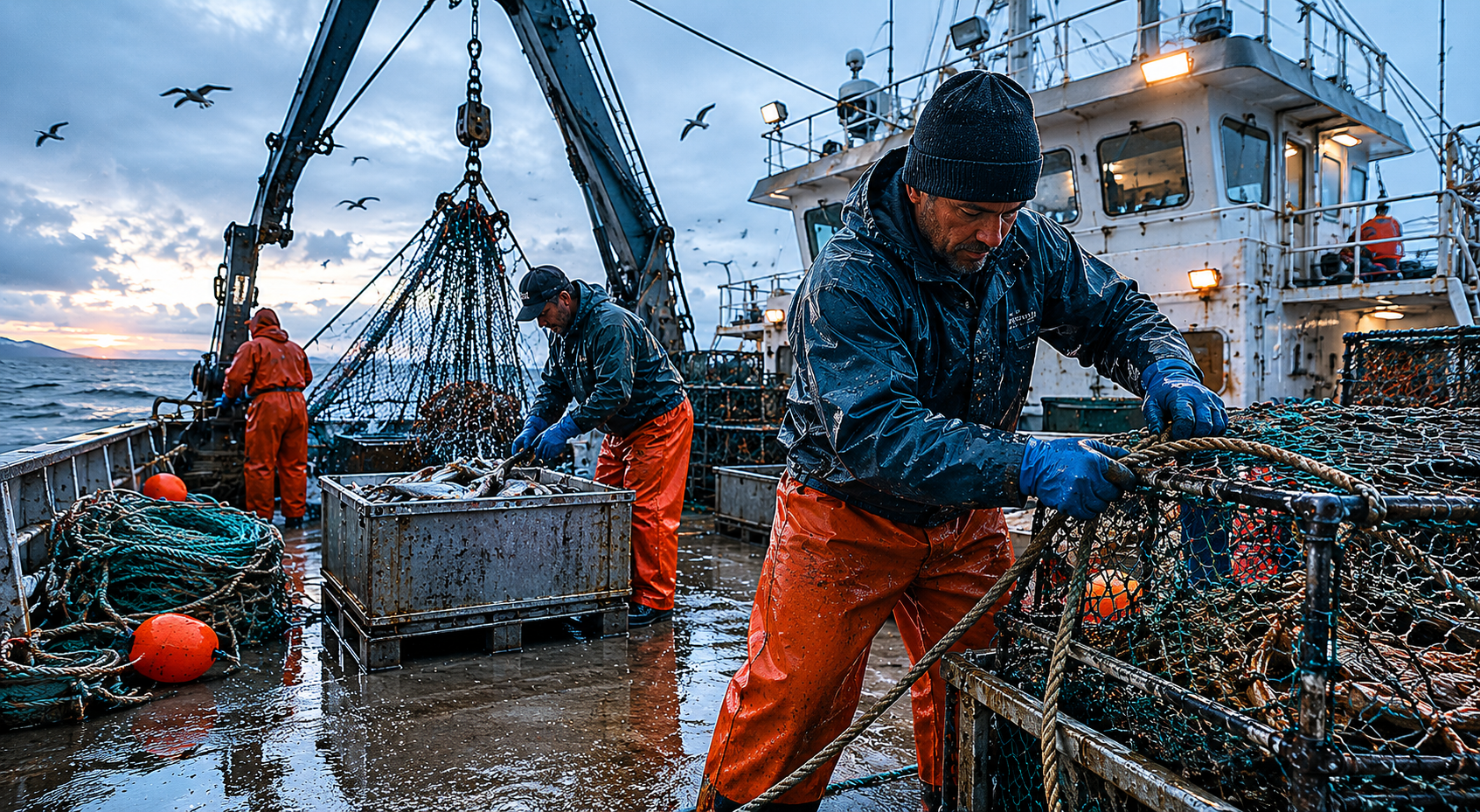
Commercial Fishing Injuries: Your Rights as an Injured Fisherman
Commercial fishing is the deadliest civilian occupation in the United States. NIOSH data shows that fishermen die on the job at roughly 29 to 40 times the rate of the average U.S. worker. If you have been hurt on a fishing vessel, or you have lost a family member at sea, here is how the law works and what your rights typically are.
In short: Most commercial fishermen are “seamen” under the Jones Act, 46 U.S.C. § 30104, because they have a substantial connection to a fishing vessel in navigation. Injured commercial fishermen typically have three overlapping remedies: Jones Act negligence claims against the employer; unseaworthiness claims against the vessel; and maintenance and cure (daily living and medical expenses until maximum medical improvement). Share-of-catch pay arrangements and remote-location injuries create unique wrinkles families should know about.
This article is for informational purposes only and does not constitute legal advice. Commercial fishing injury cases are fact-specific. Consult a licensed maritime attorney about your specific situation. See our full disclaimer.
Key Facts at a Glance
- Commercial fishing is consistently the deadliest U.S. occupation, with fatality rates that have run from roughly 117 to 128 deaths per 100,000 workers in recent decades, versus about 4 per 100,000 for all U.S. workers (Source: NIOSH / CDC Commercial Fishing Safety).
- From 2000 through 2019, NIOSH recorded 878 commercial fishing fatalities in the U.S., averaging over 43 deaths per year. (Source: NIOSH.)
- The leading causes of fishing fatalities are vessel disasters (about 47%), falls overboard (about 30%), and on-board injuries (about 14%). (Source: NIOSH.)
- Most commercial fishermen meet the Jones Act seaman test under Chandris, Inc. v. Latsis, 515 U.S. 347 (1995), because their work contributes to the function of a fishing vessel and they have a substantial connection to that vessel.
- Commercial fishermen who qualify as seamen typically have three remedies: Jones Act negligence; unseaworthiness under general maritime law; and maintenance and cure.
- Commercial fishing vessel safety is regulated by the U.S. Coast Guard, with detailed requirements in 46 CFR Part 28, including survival craft, immersion suits, life rings, EPIRBs, and safety drills.
- NIOSH found that of 170 falls-overboard fatalities studied (2000-2010), none of the victims were wearing a personal flotation device, and 57% of falls-overboard were unwitnessed. (Source: NIOSH Recommendations for Improving Commercial Fishing Safety.)
If you have worked the Bering Sea crab fishery, the Gulf shrimp boats, the Pacific Northwest salmon fleet, the East Coast scallop or lobster boats, or any other U.S. commercial fishery, you already know that injuries are not the exception, they are part of the work. Long shifts, heavy gear, slippery decks, brutal weather, and the sheer remoteness of the work make it dangerous. Maritime law has unique protections for commercial fishermen, but those protections are not automatic, and the fishing industry’s pay structures, vessel ownership patterns, and geographic isolation can create complications that don’t show up in other maritime injury cases.
This guide explains, in plain terms, what protections commercial fishermen typically have, how the unique features of fishing-industry employment affect those rights, and what to do if you or a family member has been hurt or killed on a fishing vessel.
Why Is Commercial Fishing the Deadliest U.S. Occupation?
NIOSH’s analysis of fishing fatalities consistently shows the same three categories accounting for the great majority of deaths. Vessel disasters (sinking, capsizing, fires) cause roughly 47% of fishing fatalities, with about three in five vessel-disaster deaths involving extreme weather. Falls overboard cause roughly 30%, and on-board injuries (machinery contact, struck-by-gear, falls within the vessel) cause about 14%. (Source: NIOSH.) These categories also drive non-fatal injuries, which run vastly higher than fatalities and disable many fishermen for months or permanently.
Region matters too. Alaska, the East Coast scallop and lobster fisheries, the Gulf of Mexico shrimp fishery, and the Pacific Northwest each have distinctive hazard profiles. NIOSH has published regional summaries for each. The Bering Sea crab fishery (the “Deadliest Catch” fleet) became famous because of its peak-season fatality rates, which exceeded 300 per 100,000 workers in some years, before targeted safety regulations brought rates down by 42%.
Are Commercial Fishermen Covered by the Jones Act?
In the great majority of cases, yes. The Jones Act, codified at 46 U.S.C. § 30104, gives “seamen” the right to sue their employers for negligence and recover full tort damages, including pain and suffering, lost wages, future losses, and medical expenses. Whether a worker is a “seaman” turns on the two-part test from the U.S. Supreme Court’s decision in Chandris, Inc. v. Latsis, 515 U.S. 347 (1995): (1) the worker’s duties must contribute to the function of the vessel or the accomplishment of its mission, and (2) the worker must have a connection to a vessel (or to an identifiable group of vessels) in navigation that is substantial in both duration and nature.
For a working commercial fisherman, that test is usually easy to meet. The fisherman’s work directly contributes to the vessel’s mission (catching fish), and a full-season or full-year deckhand has a substantial connection to the vessel. Captains, deckhands, engineers, processors on at-sea processing vessels, and similar fishing-vessel crew typically qualify. Workers who only briefly board a fishing vessel, or whose duties are entirely shore-based, may not.
What Remedies Do Injured Commercial Fishermen Have?
A commercial fisherman who qualifies as a seaman generally has three remedies, often pursued together, and there is also a wrongful death claim available to the family if the fisherman is killed. See our Maritime Wrongful Death guide for the death-case framework.
Jones Act Negligence Claim
The Jones Act lets a seaman sue the employer for negligence. The standard of causation is famously low: the seaman need only show the employer’s negligence “played any part, even the slightest” in producing the injury. Causes can include inadequate safety training, broken or missing equipment, fatigue from excessive hours, unsafe deck operations, inadequate crew, unrepaired hazards, or inadequate safety culture. Damages include lost wages (including future earning capacity), pain and suffering, mental anguish, disfigurement, and medical expenses.
Unseaworthiness Claim
Under general maritime law, a fishing vessel owner has a non-delegable duty to provide a “seaworthy” vessel: one whose hull, equipment, crew, and operations are reasonably fit for their intended purpose. Common unseaworthiness claims on fishing vessels include defective deck machinery, missing safety equipment, undersized crew, inadequate fire-fighting or dewatering equipment, slippery surfaces without remediation, defective lifelines or guardrails, and vessel instability for the fishery. Unseaworthiness is strict liability: the vessel owner is responsible even without negligence.
Maintenance and Cure
Independent of fault, a fishing vessel employer owes the seaman “maintenance and cure” from the moment of injury or illness arising in the service of the vessel, until the seaman reaches maximum medical improvement (MMI). Maintenance is a daily allowance for living expenses on shore (the rate varies, often $30 to $75 per day, more in some collective bargaining contexts, sometimes more depending on actual costs). Cure is reasonable medical expenses related to the condition. Willful, arbitrary refusal to pay maintenance and cure can give rise to punitive damages, per the Supreme Court in Atlantic Sounding Co. v. Townsend, 557 U.S. 404 (2009).
Hurt on a fishing vessel?
Maintenance and cure starts immediately, even before any negligence is proven. Make sure you are getting it. A free case review costs nothing and there is no obligation.
Common Causes of Commercial Fishing Injuries and Deaths
The table below shows the most common categories of commercial fishing fatalities and serious injuries, drawn from NIOSH’s analysis of the Commercial Fishing Incident Database, and the legal theories that typically apply.
| Cause | Share of fishing fatalities (NIOSH 2000-2019) | Common contributing factors | Typical legal theory |
|---|---|---|---|
| Vessel disaster (sinking, capsizing, fire) | 47% | Severe weather, flooding, instability, large wave; vessel overloading | Unseaworthiness; Jones Act negligence; DOHSA/Jones Act wrongful death |
| Fall overboard | 30% | No PFD use, unwitnessed events (57%), slippery decks, missing lifelines, single-person operations | Unseaworthiness; Jones Act negligence; wrongful death |
| On-board injury | 14% | Struck-by gear, entanglement, machinery contact (amputations), trip and fall | Jones Act negligence; unseaworthiness; product liability for defective gear |
| Diving | Smaller share, region-specific | Equipment failure, decompression issues, entanglement | Jones Act negligence; unseaworthiness; product liability |
| Shore-based injury during fishing operations | Smaller share | Cargo handling, vehicle accidents, shore-side processing | Coverage may shift to LHWCA or state workers’ comp |
| Hearing loss / repetitive injury | Substantial; often unreported | Long-term noise exposure, vibration, repetitive heavy lifting | Jones Act negligence; maintenance and cure |
How Does “Share-of-Catch” Pay Affect a Fisherman’s Claim?
Commercial fishing is unusual in U.S. labor: many fishermen are paid not a wage or salary but a “share” or “lay” of the boat’s catch after expenses. This compensation structure creates real complications when calculating an injured fisherman’s lost wages and maintenance rates.
For Jones Act and unseaworthiness claims, lost-wages damages should reflect the actual amount the fisherman could reasonably have expected to earn during the missed season(s), including the value of fish caught and the customary share percentage. Tax returns, settlement sheets, prior-year landings, and the captain’s records become the evidence. For maintenance, the daily rate is supposed to be enough to cover food and lodging on land. Older cases sometimes set very low daily rates that have not been updated; injured fishermen and their attorneys often need to push back on outdated maintenance rates that bear no relationship to actual costs.
What Are the Coast Guard Safety Rules for Fishing Vessels?
The U.S. Coast Guard regulates commercial fishing vessel safety primarily through 46 CFR Part 28. Requirements vary by vessel size, fishery, and operating area, but commonly include emergency drills, properly stowed and accessible immersion suits and life rings, throwable PFDs, survival craft, EPIRBs (Emergency Position Indicating Radio Beacons), fire-fighting equipment, dewatering equipment, communications equipment, and (in some configurations) stability information.
When a fishing vessel violates Coast Guard safety rules and that violation contributes to an injury or death, it can be powerful evidence of unseaworthiness or Jones Act negligence. Coast Guard incident reports, NTSB findings, and the vessel’s own safety records become important documents in such cases.
What About Falls Overboard and PFDs?
Falls overboard account for roughly 30% of commercial fishing deaths, and the data show two stubborn patterns: in the NIOSH 2000-2010 study, none of the 170 overboard victims studied were wearing a personal flotation device, and 57% of overboard events were unwitnessed (Source: NIOSH). For a fisherman who survives a fall overboard but is seriously injured (hypothermia, near-drowning, secondary trauma), the lack of PFDs and the inadequacy of overboard alarms can be central evidence of unseaworthiness or negligence. For families of fishermen lost overboard with no body recovered, U.S. Coast Guard search-and-rescue reports and the vessel’s voyage records become critical.
What Should an Injured Commercial Fisherman Do First?
The early days after a serious injury at sea are often chaotic, especially for fishermen from remote ports. Practical steps that almost always help:
- Report the injury immediately to the captain or vessel operator, ideally in writing, and ask that it be noted in the vessel log. If you are evacuated by Coast Guard, request a copy of the report later.
- Get medical care. Maintenance and cure obligates the employer to pay for reasonable medical care, but in practice, getting to good care from a remote port is its own challenge.
- Keep records. Photos, witness names, vessel records, settlement sheets, tax returns, prior-year landings, training records, and any safety complaints raised before the incident.
- Be very cautious about signing anything. Some employers ask injured fishermen to sign statements or releases shortly after an injury. Do not sign releases of legal rights without legal advice.
- Watch the deadlines. Most maritime injury claims must be filed within three years under 46 U.S.C. § 30106.
- Talk to a maritime attorney. Fishing-industry cases are unusual enough that general personal-injury attorneys often miss key issues (share-of-catch wage calculation, unseaworthiness theory, maintenance rate disputes).
Do Foreign Crew on U.S.-Flag Fishing Vessels Have Rights?
U.S. flag commercial fishing vessels do employ some foreign crew, particularly in distant-water fisheries. The Jones Act’s protections often reach foreign crew on U.S.-flag vessels operating in U.S. waters, although the analysis can become complex if the work is largely in foreign waters or if the employer is a foreign entity. The U.S. Supreme Court’s choice-of-law framework from Lauritzen v. Larsen, 345 U.S. 571 (1953), as modified by Hellenic Lines Ltd. v. Rhoditis, 398 U.S. 306 (1970), considers factors including the vessel’s flag, the place of the wrongful act, the law of the seaman’s home, the law of the contract, and the location of the employer’s base of operations. A maritime attorney can evaluate whether U.S. law applies to a specific foreign-crew situation.
What Compensation Can an Injured Commercial Fisherman Expect?
There is no single “average” because cases vary so widely with the severity of the injury, the strength of the negligence or unseaworthiness theory, the seaman’s earnings history, and the employer/vessel insurance available. What is more reliable to say: maintenance and cure usually starts as soon as the employer is notified of the injury and continues until MMI; Jones Act negligence and unseaworthiness claims add lost wages and pain and suffering on top of maintenance and cure; punitive damages may be available for willful refusal to pay maintenance and cure under Atlantic Sounding Co. v. Townsend; and a comparative-fault rule (not contributory bar) applies under the Jones Act, so partial fault by the fisherman reduces but does not bar recovery.
Don’t leave money on the table.
Fishermen are often the most independent workers afloat, and many never file a Jones Act claim even when they have a strong case. A free case review is a no-pressure way to understand your options.
Frequently Asked Questions
Am I covered by the Jones Act as a commercial fisherman?
If you work as a captain, deckhand, engineer, processor, or other crew member on a U.S. commercial fishing vessel, you are very likely a Jones Act “seaman.” The test from Chandris, Inc. v. Latsis (1995) requires that your duties contribute to the function of the vessel and that you have a substantial connection to that vessel in navigation. A typical full-season deckhand easily satisfies both prongs.
What is maintenance and cure, and when does it start?
Maintenance is a daily allowance for living expenses on shore (commonly $30 to $75 per day, sometimes more), and cure is reasonable medical care. Both obligations of the employer begin when you are injured or fall ill in the service of the vessel and continue until you reach maximum medical improvement. The employer’s obligation does not depend on negligence; it exists even if no one was at fault.
What if I was partly at fault for my injury?
Comparative fault under the Jones Act reduces your damages by your percentage of fault but does not bar your recovery. A finding that you were 30% at fault, for example, reduces your award by 30%; you still recover the remaining 70%. Maintenance and cure is generally not reduced for the seaman’s fault except in cases of willful misconduct.
How long do I have to file a Jones Act claim?
Generally three years from the date of injury, under 46 U.S.C. § 30106. Some specific limitations may shorten or affect the deadline in unusual circumstances. Request a free case review early; evidence in fishing-industry cases (logs, witness memories, gear) can disappear quickly.
Can I be fired for filing a Jones Act claim?
Maritime law has long protected seamen from employer retaliation for filing injury claims. Specific protections vary, and some practical considerations (like whether you want to return to the same employer) apply, but the legal framework strongly disfavors retaliation against seamen who pursue injury claims.
What if my loved one was lost at sea and the body was never recovered?
Maritime law has procedures for wrongful death claims in cases where the body is not recovered but circumstances make death legally certain (or where after a sufficient time, death is presumed). Coast Guard reports, the vessel’s voyage records, and witness accounts become critical. See our Maritime Wrongful Death guide for the wrongful death framework, including DOHSA for deaths beyond three nautical miles.
What if the vessel was unseaworthy?
Unseaworthiness is a separate cause of action under general maritime law, and it is strict liability: the vessel owner is responsible whether or not the owner was negligent, if the vessel or its equipment was not reasonably fit for its intended purpose. Common fishing-vessel unseaworthiness claims involve defective deck machinery, missing safety equipment, undersized or poorly trained crew, and unsuitable vessel configuration for the fishery.
Are processors and other shore-side fish-plant workers Jones Act seamen?
Generally no. Workers in shore-based fish processing plants are typically state workers’ compensation cases. Workers on at-sea processing vessels can be Jones Act seamen if their work and vessel connection meet the Chandris test. Workers on floating-but-permanently-moored processing platforms can be more complex; the seaman analysis depends on whether the platform is a “vessel in navigation.”
Does it matter whether I am paid by share or hourly?
For seaman status, no. For lost-wage damages and maintenance calculation, yes. Pay structure does not affect whether you are a seaman, but it does affect how damages are calculated. Insist that your attorney address share-of-catch issues directly; some general PI lawyers underestimate this.
References and Sources
- NIOSH / CDC, Commercial Fishing Safety in the United States. National Institute for Occupational Safety and Health. (Source: cdc.gov/niosh)
- NIOSH, Recommendations for Improving Commercial Fishing Safety (DHHS Publication No. 2012-129). (Source: cdc.gov)
- Jones Act, 46 U.S.C. § 30104. Legal Information Institute, Cornell Law School. (Source: law.cornell.edu)
- 46 U.S.C. § 30106 (Maritime statute of limitations). Legal Information Institute, Cornell Law School. (Source: law.cornell.edu)
- Chandris, Inc. v. Latsis, 515 U.S. 347 (1995). U.S. Supreme Court. (Source: supreme.justia.com)
- Atlantic Sounding Co. v. Townsend, 557 U.S. 404 (2009). U.S. Supreme Court. (Source: supreme.justia.com)
- Lauritzen v. Larsen, 345 U.S. 571 (1953); Hellenic Lines Ltd. v. Rhoditis, 398 U.S. 306 (1970). U.S. Supreme Court (choice-of-law factors for foreign-crew maritime claims).
- U.S. Coast Guard Commercial Fishing Vessel Safety Regulations, 46 CFR Part 28. (Source: ecfr.gov)
- Bureau of Labor Statistics, Census of Fatal Occupational Injuries. (Source: bls.gov/iif)
Editorial Standards and Review
This article was researched and written in accordance with our Editorial Standards. Fatality statistics and incident-category percentages are drawn directly from the National Institute for Occupational Safety and Health’s published analyses of the Commercial Fishing Incident Database. Legal explanations and citations are traced to authoritative primary sources: federal statutes, U.S. Supreme Court decisions, and federal regulations. We follow a zero-hallucination policy: where a fact could not be verified against a reliable source, it was not included. Last reviewed: May 2026.
This article is for general informational purposes only and does not constitute legal advice. Offshore Injury Help is not a law firm and does not provide legal advice. Reading this article does not create an attorney-client relationship. Every case is different; consult a licensed maritime attorney about your specific situation.