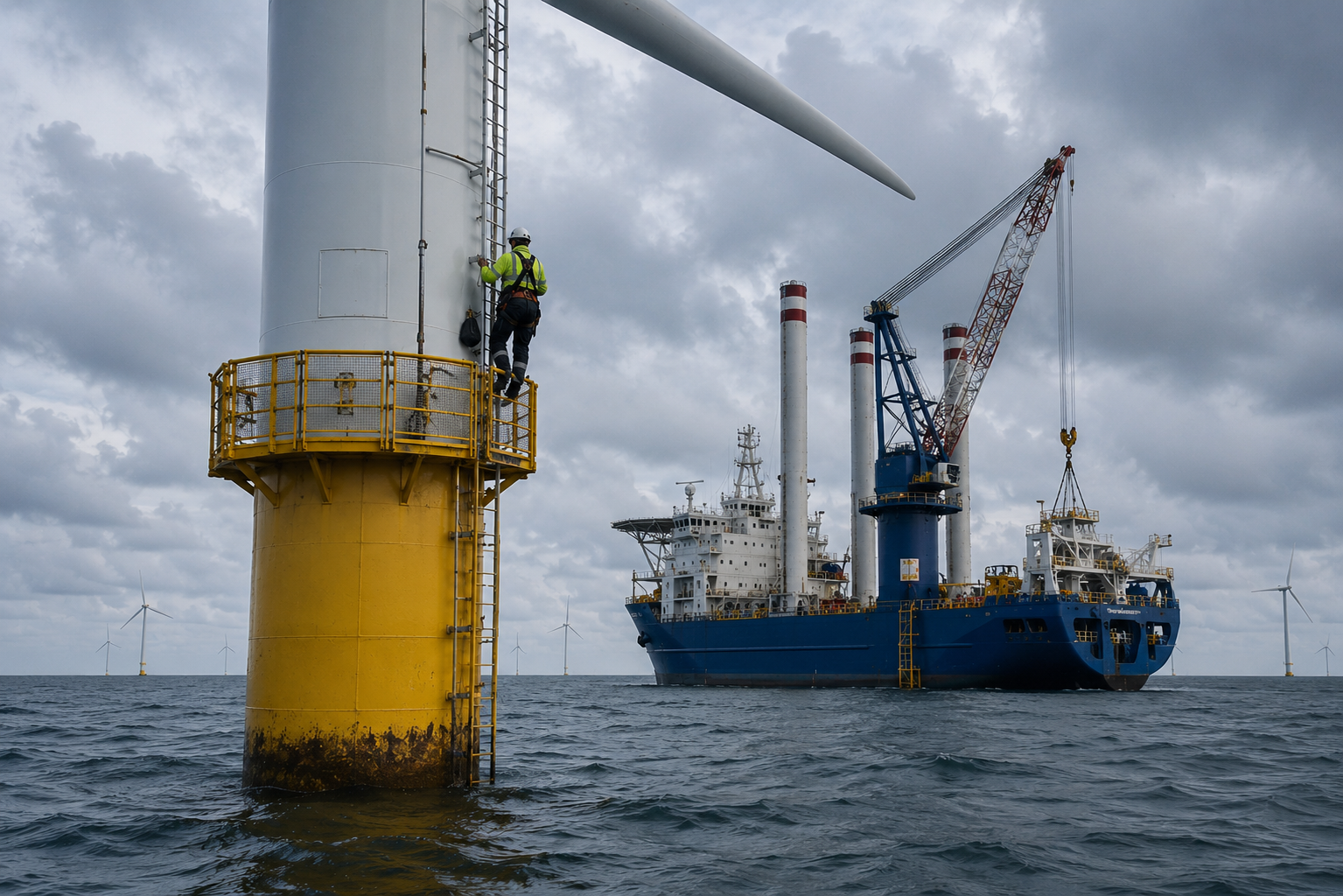
Offshore Wind Worker Injuries: Your Rights at Sea
U.S. offshore wind is a newer industry, with the first commercial-scale projects coming online over the last several years and many more in active construction along the East Coast. The legal framework that protects workers in this industry was largely written for older offshore work, oil and gas, longshore, fishing, and the wind industry does not always fit neatly into any single category. If you have been hurt on an offshore wind farm or its supporting vessels, here is how the law actually treats your case.
In short: Most workers injured on offshore wind support vessels (CTVs, SOVs, WTIVs, jack-up installation vessels) are Jones Act seamen entitled to negligence claims, unseaworthiness, and maintenance and cure. Workers on fixed turbine foundations and substations face a more complex picture, OCSLA was written for minerals, not wind, so coverage may turn on the LHWCA, OCSLA’s wind-applicability question, or state law. Federal offshore wind activities are leased and regulated by BOEM under 30 CFR Part 585.
This article is for informational purposes only and does not constitute legal advice. Offshore wind injury law is evolving rapidly and the answer in your case may turn on specific facts a maritime attorney needs to evaluate. Consult a licensed maritime attorney about your specific situation. See our full disclaimer.
Key Facts at a Glance
- The U.S. offshore wind industry is growing rapidly along the East Coast, with operational and under-construction projects including Vineyard Wind 1, South Fork Wind, Revolution Wind, Coastal Virginia Offshore Wind, and Empire Wind.
- Federal offshore wind activities on the U.S. Outer Continental Shelf are leased and regulated by the U.S. Bureau of Ocean Energy Management (BOEM) under 30 CFR Part 585.
- Workers on offshore wind support vessels typically qualify as Jones Act seamen under Chandris, Inc. v. Latsis, 515 U.S. 347 (1995), with full rights to negligence claims, unseaworthiness, and maintenance and cure.
- Whether the Outer Continental Shelf Lands Act (OCSLA), 43 U.S.C. ch. 29, extends LHWCA coverage to fixed wind turbine foundations is a real legal question; OCSLA was originally written for “exploration, development, and production” of minerals, and Congress has considered, but not always passed, updates clarifying offshore wind.
- The U.S. Coast Guard regulates offshore wind support vessels and the safety zones around projects under existing maritime authorities.
- The work involves specialized vessels: CTVs (Crew Transfer Vessels), SOVs (Service Operation Vessels), WTIVs (Wind Turbine Installation Vessels), and jack-up vessels, each with distinctive hazard profiles.
- Injuries on offshore wind projects can include fall injuries (turbine climbing, tower work), crush injuries during installation, vessel collisions (CTV-to-monopile contact), drowning, electrical injuries, and exposure to weather.
If you work as a wind technician, deckhand on a CTV, engineer on a SOV, crane operator on a WTIV, electrician on a substation, or in any other offshore wind role, the law that protects you depends on a combination of factors: whether your work makes you a Jones Act seaman, where the injury happened (a vessel, a fixed foundation, an installation platform), the project’s lease status under BOEM, and the activities involved. The good news for most offshore wind workers is that maritime law is generous when it applies. The bad news is that the categories are not always clear-cut for an industry the older statutes did not contemplate.
This guide explains the framework in plain terms, with specific attention to the vessel-vs-fixed-structure distinction that drives many of the answers, the OCSLA-wind question that competitor pages routinely gloss over, and the practical steps to take if you have been hurt.
What Vessels and Structures Make Up an Offshore Wind Project?
Understanding the vessel and structure types helps explain why the legal categorization can be confusing. A typical offshore wind project involves:
- Wind Turbine Installation Vessels (WTIVs), often large jack-up vessels with massive cranes, used to install turbine foundations, towers, nacelles, and blades.
- Crew Transfer Vessels (CTVs), smaller, fast catamarans (often 20 to 30 meters) that ferry technicians and crew daily between shore and turbines.
- Service Operation Vessels (SOVs), larger purpose-built vessels with onboard accommodation, used for longer-term offshore maintenance crews.
- Cable-laying vessels, used to install the inter-array and export cables that connect turbines to shore.
- Tugboats, supply vessels, and survey vessels supporting all phases of construction and operation.
- Fixed structures, the monopile or jacket foundations, transition pieces, towers, nacelles, and offshore substations.
For Jones Act purposes, workers on vessels in navigation, the CTVs, SOVs, WTIVs, cable-layers, tugboats, are usually seamen. Workers permanently assigned to fixed structures (the foundations, the substation), are typically not, although jack-up vessels in “jacked-down” navigation mode raise complex questions similar to oil and gas jack-up rigs covered in our offshore oil and gas pillar.
Are Offshore Wind Workers Covered by the Jones Act?
If the worker is a member of the crew of a vessel in navigation, yes. The two-part test from Chandris, Inc. v. Latsis, 515 U.S. 347 (1995), asks whether the worker’s duties contribute to the function of the vessel and whether the worker has a substantial connection to the vessel (or to an identifiable group of vessels) in navigation. A wind technician spending most of his or her time on a SOV, a captain or deckhand on a CTV, a crane operator on a WTIV, or an engineer on a cable-laying vessel typically meets both prongs.
Once Jones Act seaman status applies, the worker has access to three remedies that maritime law has refined over a century: Jones Act negligence (against the employer, under 46 U.S.C. § 30104), unseaworthiness (against the vessel, under general maritime law), and maintenance and cure (a daily living allowance and reasonable medical care from injury to maximum medical improvement). See our Jones Act guide for the substantive details of how these remedies work.
What If I Was Injured on a Turbine Foundation or Substation?
This is where the law gets genuinely interesting, and where competitor pages routinely simplify too much. Fixed offshore wind structures are not vessels. A worker on a fixed turbine foundation or substation is generally not a Jones Act seaman. The question is what law covers that worker instead.
Does OCSLA Apply to Wind?
The Outer Continental Shelf Lands Act, 43 U.S.C. ch. 29, was enacted in 1953 to govern “exploration, development, and production” of oil, gas, and other minerals on the U.S. Outer Continental Shelf, and it extends LHWCA coverage to workers injured on fixed platforms used for those activities. Wind energy was not contemplated by the original statute. The 2005 Energy Policy Act amended OCSLA to authorize the Secretary of the Interior to grant leases on the OCS for renewable energy, including wind, but the question of whether the LHWCA extension under OCSLA’s worker-protection provisions automatically applies to wind workers is not the same question and is less settled than for oil and gas workers. Courts and the U.S. Department of Labor have addressed pieces of this, and the answer often turns on the specific worker, project, and injury.
What this means in practice: an attorney evaluating a fixed-structure offshore wind injury has to look carefully at whether OCSLA-LHWCA applies, whether the LHWCA applies directly (because the work meets the status and situs tests on its own), or whether state workers’ compensation applies. This is one of the most important early questions in a case, and getting it wrong can affect everything that follows.
What If LHWCA Applies Directly?
For some offshore wind construction and maintenance work performed near shore or in the assembly of components in port, the LHWCA may apply on its own terms, the worker engages in maritime employment (status test) on or near U.S. navigable waters (situs test). See our LHWCA / Longshore guide for the substantive details.
What About State Workers’ Compensation?
For some onshore offshore-wind-supporting work (port-side assembly, equipment fabrication, onshore substation work), state workers’ compensation may apply. State workers’ compensation is no-fault and faster to access than maritime law remedies, but typically caps benefits at a much lower level than what the Jones Act, unseaworthiness, or even LHWCA-with-905(b) can recover.
Not sure which law covers your case?
Offshore wind injury claims are genuinely complex because the industry is new and the statutes were not written for it. A free case review with a maritime attorney is the right first step.
Which Law Applies to Which Offshore Wind Worker?
The table below maps the most common offshore wind work situations to the law that typically applies. Like all maritime injury categorization, the actual answer is fact-specific and a maritime attorney can evaluate the details of your case.
| Worker / situation | Primary law that typically applies | Damages available |
|---|---|---|
| Captain, deckhand, engineer on a CTV, SOV, WTIV, or cable-laying vessel | Jones Act + general maritime law | Full tort damages, pain and suffering, lost wages, M&C, unseaworthiness |
| Wind technician spending most time on a SOV, transferring daily to turbines | Typically Jones Act + general maritime law | Full tort damages, M&C, unseaworthiness |
| Wind technician permanently assigned to a single fixed turbine or substation | LHWCA (if status/situs met); OCSLA-LHWCA question; possibly state law | LHWCA benefits + potential 905(b) vessel claim if vessel negligence contributed |
| Cable installation crew on a cable-laying vessel | Jones Act + general maritime law (vessel crew) | Full tort damages, M&C, unseaworthiness |
| Worker injured on a fixed offshore substation by a third party | LHWCA-or-state for employer; Section 905(b) against vessel if vessel involved; tort against third party | LHWCA benefits + potential third-party recovery |
| Onshore fabrication or assembly worker (port-side) | Likely state workers’ compensation; LHWCA possible if status/situs met | State comp benefits, capped at state limits |
| Wrongful death of offshore wind worker beyond 3 nautical miles | DOHSA + Jones Act (if seaman) + general maritime law | DOHSA pecuniary damages + Jones Act broader damages where applicable |
What Are the Common Causes of Offshore Wind Injuries?
Studies of offshore wind safety have identified several recurring hazard categories. Many overlap with hazards in other offshore work, but the wind industry has some distinctive features.
Vessel-to-Foundation Contact (CTV Push-On)
CTVs transfer crew to turbines by “pushing on” against a foundation rubber-fender system while a technician steps across to a ladder. Wave conditions, vessel handling, and fender wear can all create injury risk during transfer. Falls into the water between vessel and foundation are a documented hazard. CTV-to-foundation contact incidents have been reported during the brief windows of routine transfer.
Tower and Turbine Climbing Injuries
Wind technicians often climb tall turbine towers using ladder systems with personal fall-arrest equipment. Falls from height, dropped tools, fatigue, and equipment failures are recognized hazards. The remoteness of the work site complicates emergency response.
Crush and Struck-By Injuries During Installation
Heavy installation operations, lifting monopile foundations, transition pieces, towers, nacelles, blades, all create risk of crush and struck-by injuries to deck and crane crews. WTIVs and jack-up vessels operate with massive cranes near unstable lifts.
Electrical Injuries
Offshore substations carry significant voltage. Workers performing maintenance face electrical hazards similar to other electrical-utility work but compounded by the offshore setting.
Weather and Sea-State Hazards
Offshore weather imposes structural and operational stresses on towers, foundations, and vessels. Severe storms have damaged operational turbines and contributed to vessel incidents.
Drowning and Hypothermia
Falls overboard from CTVs or installation platforms can rapidly become fatal in cold North Atlantic waters even when survival suits are worn.
How Are Offshore Wind Projects Regulated?
Several federal agencies share regulatory roles on the U.S. Outer Continental Shelf:
- BOEM (Bureau of Ocean Energy Management) issues offshore wind leases and approves project plans under 30 CFR Part 585.
- BSEE (Bureau of Safety and Environmental Enforcement) historically focused on oil and gas inspections; its role for wind has been evolving, including a 2024 reorganization to focus more on renewable energy enforcement.
- USCG (U.S. Coast Guard) regulates vessels (including CTVs, SOVs, WTIVs) and the safety zones around offshore wind projects.
- OSHA regulates worker safety in onshore facilities and some offshore situations.
- NOAA manages fisheries and environmental issues that can affect project siting and operations.
When a project violates a federal safety or operational regulation and the violation contributes to an injury, that fact can support a finding of negligence under the Jones Act or LHWCA, or an unseaworthiness theory under general maritime law. Agency incident reports, BOEM project filings, BSEE inspection records, and USCG reports can all become important evidence in serious offshore wind injury cases.
What Did the 2021 DHS Jones Act Determination Mean?
In late 2021, the U.S. Department of Homeland Security determined that the Jones Act, which generally requires U.S.-built, U.S.-flagged, U.S.-crewed vessels for transportation of merchandise between U.S. points, applies to vessels servicing U.S. offshore wind projects. This is primarily a coastwise-trade and commerce question (affecting which vessels can operate in U.S. offshore wind), not directly about injured-worker protections, but it has practical effects for the industry. As more U.S.-flagged specialized vessels enter service, more workers on those vessels will be U.S. seamen with full Jones Act injury protections.
What Should an Injured Offshore Wind Worker Do First?
- Report the injury immediately in writing to your supervisor, captain, or safety officer, and ask that it be logged in the vessel or project record.
- Get medical care, including, if necessary, requesting evacuation by Coast Guard or vessel for serious injuries. Keep copies of all medical records.
- Document the scene if you can do so safely: photos of the injury, equipment involved, weather conditions, work crew, and any obvious hazards.
- Identify witnesses by name and contact information. CTV transfers, turbine work, and vessel operations often have small crews with concentrated knowledge.
- Preserve your employment records, including your job description, your assignments, the vessel(s) you worked on, and the percentage of your time on each.
- Be cautious about signing documents. Some employers ask injured workers to sign statements or releases shortly after an injury. Do not sign releases of legal rights without legal advice.
- Watch deadlines. Maritime statutes give three years from injury under 46 U.S.C. § 30106; LHWCA cases need notice in 30 days and a formal claim within one year; state systems have their own timelines.
- Consult a maritime attorney quickly, because the threshold question (which law applies) shapes everything that follows. Generalist personal-injury attorneys often miss the seaman-vs-not-seaman analysis in offshore wind cases.
What Compensation Can an Injured Offshore Wind Worker Recover?
Compensation depends heavily on which law applies. A Jones Act seaman on a CTV or SOV with a strong negligence or unseaworthiness theory can recover full tort damages, lost wages and future earning capacity, pain and suffering, medical expenses, plus M&C until MMI. An LHWCA-covered worker recovers two-thirds-of-AWW disability benefits plus medical care, with potential additional recovery through a Section 905(b) vessel-negligence claim where applicable. A worker covered only by state workers’ compensation recovers state-capped benefits. The differences across these categories can be large in dollar terms, especially for serious injuries.
Offshore wind is a new industry; injury law applied to it is still developing.
That makes the choice of attorney especially important. A free case review with someone who knows offshore wind, not just generic personal injury, costs nothing and helps you understand what you’re working with.
Frequently Asked Questions
Are offshore wind workers Jones Act seamen?
If you are a member of the crew of a vessel in navigation (a CTV, SOV, WTIV, cable-laying vessel, supply vessel, or jack-up in jacked-down mode), almost always yes. The Chandris v. Latsis (1995) two-part test is comfortably met by typical offshore wind vessel crew. Workers permanently assigned to fixed turbine foundations or substations generally are not seamen; they may instead be covered by the LHWCA, OCSLA-LHWCA (a complex question for wind), or state law.
Does the Outer Continental Shelf Lands Act apply to offshore wind?
OCSLA itself was extended to authorize offshore wind leases by the 2005 Energy Policy Act amendments. Whether OCSLA’s worker-protection provisions automatically extend LHWCA coverage to wind workers on fixed structures the way they do for oil and gas workers is less settled, because the original OCSLA worker provisions referred to “exploration, development, and production” of minerals. The answer in a specific case can turn on the worker, the project, and the injury. A maritime attorney should evaluate this question early.
What is a CTV, and what makes it dangerous?
A Crew Transfer Vessel is a smaller, fast catamaran used to ferry technicians and crew daily between shore and offshore turbines. CTVs transfer crew by “pushing on” against a turbine foundation’s fender system while a technician steps across to a ladder. The transfer happens in seas that can range from calm to challenging, and the brief windows of physical contact between vessel and foundation create injury risk if conditions or equipment are not right.
What is the difference between a WTIV and a CTV?
WTIVs (Wind Turbine Installation Vessels) are large jack-up vessels with massive cranes used to install foundations, towers, nacelles, and blades, mostly during the construction phase of a project. CTVs are small, fast catamarans used routinely throughout construction and operation to transfer personnel. Workers on either are typically Jones Act seamen, but the work and hazards differ substantially.
How long do I have to file an offshore wind injury claim?
For maritime claims (Jones Act, unseaworthiness, M&C), generally three years from the injury under 46 U.S.C. § 30106. For LHWCA claims, you must give written notice within 30 days and file a formal claim within one year. State workers’ compensation systems have their own deadlines, often even shorter. Request a free case review if you are uncertain.
What if my employer says it is too early to know if I have a serious injury?
Document everything and seek independent medical care. The “wait and see” approach can disadvantage injured workers, especially when carriers later argue that delayed symptoms are not work-related. Get the diagnosis and treatment you need from a provider you trust, and consult a maritime attorney early about preserving your rights.
What about offshore wind workers from Europe or other foreign countries?
Foreign nationals working on U.S. offshore wind projects may have rights under U.S. maritime law, particularly if they work on U.S.-flagged vessels in U.S. waters. The choice-of-law analysis under Lauritzen v. Larsen (1953) and Hellenic Lines Ltd. v. Rhoditis (1970) considers factors including the vessel’s flag, the place of injury, the law of the seaman’s home, and the employer’s base of operations.
What if I was killed working on offshore wind, what can my family do?
Maritime wrongful death law applies. For deaths beyond three nautical miles, DOHSA governs; for seamen, the Jones Act adds further remedies; for non-seafarer deaths in U.S. waters, general maritime law (Moragne) and sometimes state law (per Yamaha v. Calhoun) apply. See our Maritime Wrongful Death guide for the full framework.
Is the Coast Guard the right place to report?
The U.S. Coast Guard receives reports of marine casualties and maritime safety incidents and can be the appropriate authority for serious vessel-related events. For project-side regulatory violations (BOEM/BSEE matters) or worker safety regulations (OSHA), different agencies may have roles. An attorney can help identify the right reporting channels for your specific situation.
References and Sources
- Outer Continental Shelf Lands Act, 43 U.S.C. ch. 29. Legal Information Institute, Cornell Law School. (Source: law.cornell.edu)
- Renewable Energy and Alternate Uses of Existing Facilities on the Outer Continental Shelf, 30 CFR Part 585 (BOEM regulations). (Source: ecfr.gov)
- Jones Act, 46 U.S.C. § 30104. Legal Information Institute, Cornell Law School. (Source: law.cornell.edu)
- 46 U.S.C. § 30106 (Maritime statute of limitations). Legal Information Institute, Cornell Law School. (Source: law.cornell.edu)
- Longshore and Harbor Workers’ Compensation Act, 33 U.S.C. ch. 18. Legal Information Institute, Cornell Law School. (Source: law.cornell.edu)
- Chandris, Inc. v. Latsis, 515 U.S. 347 (1995). U.S. Supreme Court. (Source: supreme.justia.com)
- U.S. Bureau of Ocean Energy Management (BOEM), Renewable Energy on the Outer Continental Shelf. (Source: boem.gov/renewable-energy)
- U.S. Coast Guard (vessel safety, casualty reporting). (Source: uscg.mil)
- U.S. Bureau of Safety and Environmental Enforcement (BSEE). (Source: bsee.gov)
Editorial Standards and Review
This article was researched and written in accordance with our Editorial Standards. Every legal explanation, statute citation, federal regulation, and agency reference is traced to authoritative primary sources: federal statutes, federal regulations, U.S. Supreme Court decisions, and U.S. federal agencies. We follow a zero-hallucination policy: where a fact could not be verified against a reliable source, it was not included. Offshore wind injury law is an evolving area, and this guide is reviewed and updated as the law develops. Last reviewed: May 2026.
This article is for general informational purposes only and does not constitute legal advice. Offshore Injury Help is not a law firm and does not provide legal advice. Reading this article does not create an attorney-client relationship. Every case is different; consult a licensed maritime attorney about your specific situation.