The Most Dangerous Commercial Fishing Jobs in America
The most dangerous commercial fishing jobs are not spread evenly across the industry; some regions, fisheries, and tasks kill far more workers than others. Here is what the federal data shows about which fishing work is deadliest, and what the law does for fishermen who are hurt or killed.
This article is for informational purposes only and does not constitute legal advice. If you were hurt fishing, or you lost a family member at sea, your rights depend on the specific facts; to understand them, consult a licensed maritime attorney. This article discusses workplace fatalities, which some readers may find difficult.
Key Facts at a Glance
- From 2000 to 2019, 878 U.S. commercial fishermen died from traumatic injury, averaging more than 43 deaths per year (Source: CDC / NIOSH).
- Vessel disasters caused 414 deaths (47 percent) and falls overboard caused 266 deaths (30 percent) over that period (Source: CDC / NIOSH).
- By region, most deaths occurred on the East Coast (288, 33 percent), then Alaska (236, 27 percent), the Gulf of Mexico (201, 23 percent), and the West Coast (141, 16 percent) (Source: CDC / NIOSH).
- The Bering Sea crab fleet, the “Deadliest Catch” fishery, had a fatality rate of 770 per 100,000 workers in the late 1990s, with about 8 deaths a year (Source: CDC / NIOSH).
- After 1999 U.S. Coast Guard dockside stability checks and a 2005 quota system, Bering Sea crab deaths fell to fewer than 1 per year (Source: CDC / NIOSH).
- In a NIOSH study of 204 fall-overboard deaths from 2000 to 2016, none of the victims was wearing a personal flotation device (Source: CDC / NIOSH).
- In 2023 the farming, fishing, and forestry occupation group had a fatal injury rate of 24.4 per 100,000 workers, against 3.5 for all U.S. workers (Source: BLS CFOI).
Hurt on a fishing vessel, or lost a loved one at sea? You likely have Jones Act rights worth far more than a quick payout.
We are not a law firm and not attorneys; we connect injured maritime workers and families with experienced maritime attorneys at no cost.
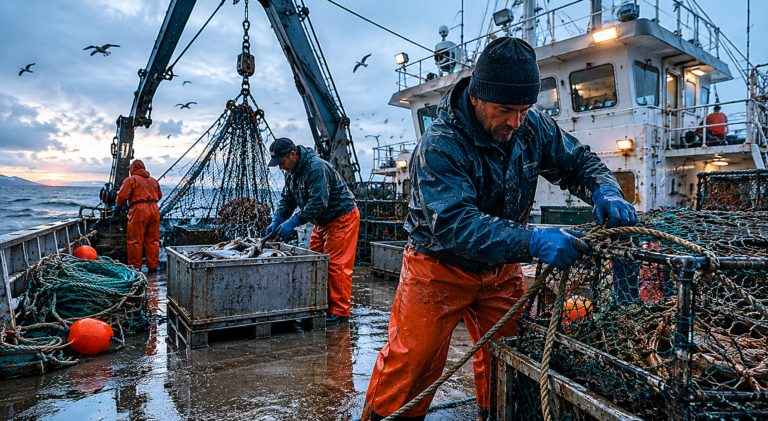
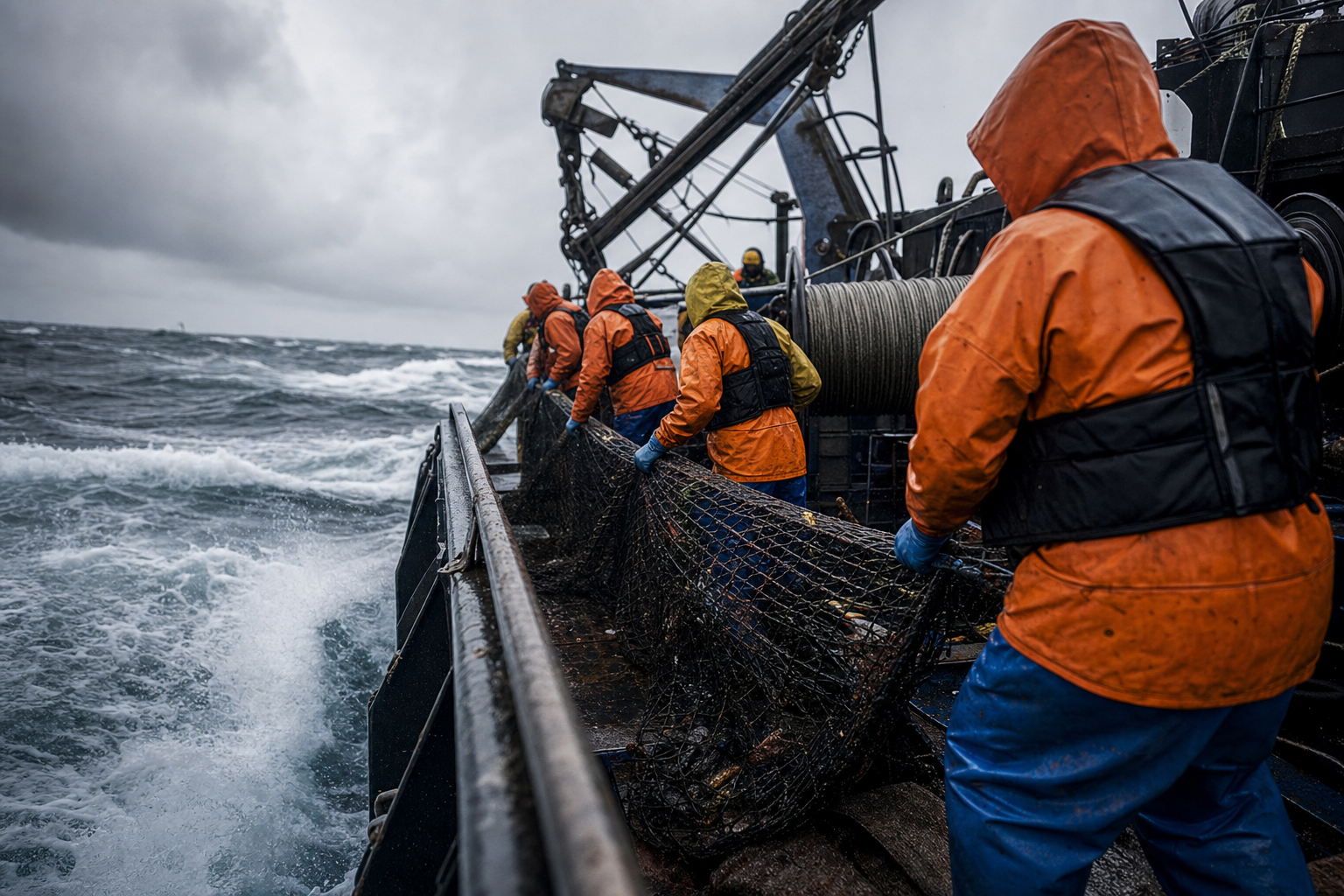
Few jobs put workers in harm’s way as reliably as commercial fishing. Crews work long hours on pitching decks, in cold water, far from rescue, around heavy gear and powerful machinery, often in weather that would keep any other workforce indoors. The federal government has tracked these deaths for decades through the National Institute for Occupational Safety and Health, and the data tells a clear story about which fisheries and which hazards are the most lethal.
This guide lays out that data: how commercial fishing compares to other occupations, which regions and fisheries are deadliest, what actually kills fishermen, and why falls overboard are so often fatal. It then explains the legal protections an injured fisherman or a grieving family has, because nearly every deckhand on a commercial vessel is a Jones Act seaman with rights that ordinary land-based workers do not have.
How Dangerous Is Commercial Fishing Compared to Other Jobs?
Commercial fishing is many times more dangerous than the average American job. NIOSH found that the fishing fatality rate was roughly 23 times higher than the rate for all U.S. workers in 2016, and the broader farming, fishing, and forestry occupation group recorded a fatal injury rate of 24.4 per 100,000 workers in 2023, compared with just 3.5 for all workers (Source: BLS CFOI). The fishing-specific rate is higher still, because fishing is the most hazardous occupation within that group. Over the two decades from 2000 to 2019, 878 fishermen died from traumatic injury, an average of more than 43 deaths every year (Source: CDC / NIOSH). The rate has fallen over time thanks to targeted safety programs, but commercial fishing remains at or near the top of every list of America’s deadliest jobs.
| Worker group | Fatal injury rate per 100,000 (2023) | Source |
|---|---|---|
| All U.S. workers | 3.5 | BLS CFOI 2023 |
| Farming, fishing, and forestry occupations | 24.4 | BLS CFOI 2023 |
| Transportation and material moving | 13.6 | BLS CFOI 2023 |
| Construction and extraction | 12.9 | BLS CFOI 2023 |
| Bering Sea crab fleet (late 1990s, historic) | 770 | CDC / NIOSH |
What Are the Most Dangerous Commercial Fishing Jobs by Region?
The deadliest regions are the East Coast, Alaska, and the Gulf of Mexico, and within them specific fisheries carry outsized risk. From 2000 to 2019, the East Coast led with 288 deaths (33 percent), followed by Alaska with 236 (27 percent), the Gulf of Mexico with 201 (23 percent), and the West Coast with 141 (16 percent) (Source: CDC / NIOSH). The danger concentrates by fishery: Gulf of Mexico shrimping, Alaska salmon and cod, Northeast groundfish and scallop, East Coast lobster, and West Coast Dungeness crab all appear repeatedly in the fatality record. NIOSH’s study of falls overboard found the most deaths in Gulf shrimp, East Coast lobster, Alaska salmon drift gillnet, and East Coast scallop operations (Source: CDC / NIOSH). The table below summarizes the regional pattern.
| Region | Deaths 2000-2019 | Share | High-risk fisheries |
|---|---|---|---|
| East Coast | 288 | 33% | Scallop, lobster, groundfish |
| Alaska | 236 | 27% | Salmon, cod, Bering Sea crab |
| Gulf of Mexico | 201 | 23% | Shrimp |
| West Coast | 141 | 16% | Dungeness crab |
| Hawaii / Pacific | 12 | 1% | Longline |
Why Were Alaska Crab Boats So Deadly, and What Changed?
The Bering Sea and Aleutian Islands crab fleet, the fishery made famous as the “Deadliest Catch,” was once the most lethal fishing job in the country, and its turnaround is the clearest safety success story in the industry. In the late 1990s the fishery had a fatality rate of about 770 per 100,000 workers and averaged roughly 8 deaths a year, often during derby-style seasons that lasted only a few days, with boats capsizing after overloading and ice buildup on crab pots (Source: CDC / NIOSH). After NIOSH presented the data to the U.S. Coast Guard, the Coast Guard launched preseason dockside stability and safety checks in 1999, and in 2005 the fishery shifted from a race-to-fish derby to a quota system. Deaths fell from about 8 a year to fewer than 1, and Alaska fishing fatalities overall dropped about 70 percent between 1990 and 2023 (Source: CDC / NIOSH).
What Causes Most Commercial Fishing Deaths?
Two hazards dominate: vessel disasters and falls overboard. From 2000 to 2019, vessel disasters such as capsizing, flooding, and sinking caused 414 deaths (47 percent), and falls overboard caused 266 (30 percent), with on-board injuries accounting for 122 (14 percent) and diving or onshore incidents for 76 (9 percent) (Source: CDC / NIOSH). Heavy weather is the most common trigger of vessel disasters, and instability from overloaded or improperly stowed gear is a recurring factor. The pattern points to where prevention matters most: vessel stability, watertight integrity, and keeping crew members on deck and out of the water. The table below breaks the causes down.
| Cause of death (2000-2019) | Deaths | Share | Typical circumstances |
|---|---|---|---|
| Vessel disaster | 414 | 47% | Capsizing, flooding, sinking, often in heavy weather |
| Fall overboard | 266 | 30% | Lost balance on deck; frequently unwitnessed; no PFD |
| On-board injury | 122 | 14% | Machinery, gear entanglement, struck-by events |
| Diving or onshore | 76 | 9% | Dive-related and shore-side incidents |
If a fishing vessel’s condition or crew failures caused an injury, the owner may be liable. Have the facts reviewed.
We are not a law firm and not attorneys; we connect injured maritime workers and families with experienced maritime attorneys at no cost.
Why Are Falls Overboard So Deadly?
Falls overboard are lethal because the victim is usually in the water before anyone knows, and almost never wearing flotation. In a NIOSH study of 204 fall-overboard deaths from 2000 to 2016, none of the victims was wearing a personal flotation device, and a majority of falls were not witnessed by other crew (Source: CDC / NIOSH). A worker who goes over the side unseen, with no PFD, in cold water, has very little time before hypothermia and drowning take over. That is why NIOSH urges every deckhand to wear a PFD while working on deck and recommends man-overboard alarms and recovery drills. The deadliest fisheries for falls overboard were Gulf shrimp, East Coast lobster, Alaska salmon drift gillnet, and East Coast scallop (Source: CDC / NIOSH).
What Are the Most Common Non-Fatal Fishing Injuries?
For every death, many more fishermen are seriously hurt and survive, often with life-changing injuries. The common patterns track the work: hands and arms caught in winches, blocks, and net reels; crew struck or crushed by gear, hatch covers, or shifting catch; deep lacerations from knives and cables; fractures from falls on wet, moving decks; and back, shoulder, and repetitive-strain injuries from hauling heavy loads. Crowded decks, fatigue from long shifts, and the absence of machine guarding make these injuries more frequent and more severe than on shore. These are the injuries that most often lead to Jones Act claims, because they leave a fisherman unable to work while bills accumulate and raise the question of whether the vessel or its equipment was reasonably safe.
What Legal Protections Do Injured Fishermen Have?
Most commercial fishermen are Jones Act seamen, which gives them stronger rights than land-based workers’ compensation. A fisherman with a substantial connection to a vessel in navigation can sue the employer for negligence under the Jones Act, can pursue an unseaworthiness claim against the vessel owner for an unsafe boat or gear, and is owed maintenance and cure regardless of fault until reaching maximum medical improvement. Jones Act negligence uses a low, featherweight causation standard, meaning the employer is liable if its negligence played any part, however slight, in causing the injury. We explain seaman status for fishermen in our guide on whether commercial fishermen are covered by the Jones Act. Families who lose a fisherman at sea may have wrongful death claims under the Jones Act and general maritime law.
Who Is Liable When a Fishing Vessel Is Unseaworthy?
The vessel owner is liable when an unseaworthy condition causes injury, and unseaworthiness covers far more than a leaking hull. A vessel is unseaworthy if its gear is defective, its equipment is missing or broken, it is undermanned, or its crew is untrained for the task, and the owner’s duty to provide a seaworthy vessel is nearly absolute, meaning the owner can be liable even without negligence. On a fishing boat, that can include a worn winch cable that snaps, a deck with no non-skid surface, a missing guard on a net reel, or a crew too small to handle the gear safely. The combination of Jones Act negligence and unseaworthiness is powerful, because the two theories reach both the employer’s careless conduct and the boat’s unsafe condition.
Worked example: A deckhand’s arm is pulled into an unguarded net reel that the owner knew was missing its safety cover. He can pursue Jones Act negligence for the failure to fix a known hazard and unseaworthiness for the defective equipment, and he is owed maintenance and cure during his recovery regardless of who was at fault.
How Can Fishermen and Owners Reduce These Risks?
The data points to concrete, proven measures. Vessel stability is the single most important factor, since overloading and icing drive the capsizings that cause nearly half of all deaths, which is why the Coast Guard’s dockside stability checks were so effective in the crab fleet (Source: CDC / NIOSH). Wearing a personal flotation device on deck addresses the fall-overboard deaths that consistently involve no flotation, and man-overboard alarms and recovery drills shorten the time a worker spends in the water (Source: CDC / NIOSH). Emergency position-indicating radio beacons, immersion suits, watertight integrity, machine guarding, and realistic crew training round out the list. None of these is exotic; the safety record improves wherever they are adopted and enforced.
Frequently Asked Questions
What are the most dangerous commercial fishing jobs?
The most dangerous commercial fishing jobs are those exposed to vessel disasters and falls overboard, which together cause about 77 percent of fishing deaths. Historically the Bering Sea crab fishery was the deadliest, while Gulf of Mexico shrimping, Alaska salmon and cod, and East Coast scallop and lobster fisheries continue to account for many fatalities.
How dangerous is commercial fishing compared to other jobs?
Commercial fishing is many times more dangerous than the average job. NIOSH found the fishing fatality rate was about 23 times the all-worker rate in 2016, and the broader farming, fishing, and forestry group ran 24.4 deaths per 100,000 workers in 2023 against 3.5 for all workers. Fishing is the most hazardous occupation within that group.
What is the leading cause of death in commercial fishing?
Vessel disasters are the leading cause, responsible for 47 percent of U.S. fishing deaths from 2000 to 2019, followed by falls overboard at 30 percent. Heavy weather and loss of vessel stability from overloading or icing are common triggers of the capsizings and sinkings behind most disaster deaths.
Why are falls overboard so often fatal?
Falls overboard are usually fatal because they frequently go unwitnessed and the victims are almost never wearing flotation. In a NIOSH study of 204 fall-overboard deaths, none of the workers was wearing a personal flotation device. In cold water, a worker who goes over the side unseen has very little time before drowning or hypothermia.
Are commercial fishermen covered by the Jones Act?
Yes, most are. A fisherman with a substantial connection to a vessel in navigation is a Jones Act seaman and can sue the employer for negligence, bring an unseaworthiness claim, and receive maintenance and cure. See our full explanation of Jones Act coverage for fishermen.
What can I recover if I am injured fishing?
An injured fisherman who is a seaman can recover lost wages and earning capacity, medical expenses, and pain and suffering through a Jones Act or unseaworthiness claim, plus maintenance and cure during recovery. See what commercial fishing settlements typically involve.
What should a fisherman’s family do after a death at sea?
Families may have wrongful death claims under the Jones Act and general maritime law, and for deaths beyond 3 nautical miles, the Death on the High Seas Act may govern and limit recovery to pecuniary loss. Because the location and the worker’s status drive the analysis, the family should have the facts reviewed by a maritime attorney.
If you were hurt fishing, or your family lost someone at sea, find out what your claim is worth before you settle.
We are not a law firm and not attorneys; we connect injured maritime workers and families with experienced maritime attorneys at no cost.
References and Sources
- CDC / NIOSH, Commercial Fishing Safety, national and regional fatality summaries
- CDC / NIOSH, Commercial Fishing Safety: Alaska and the Bering Sea crab fleet
- CDC / NIOSH, Fatal Falls Overboard in Commercial Fishing, 2000-2016
- U.S. Bureau of Labor Statistics, Census of Fatal Occupational Injuries, 2023
- U.S. Bureau of Labor Statistics, Injuries, Illnesses, and Fatalities program
- CDC / NIOSH, Commercial Fishing Safety program overview
- Jones Act, 46 U.S.C. § 30104, Cornell LII
- Maritime statute of limitations, 46 U.S.C. § 30106, Cornell LII
- Offshore Injury Help, Commercial Fishing Injuries overview
- Offshore Injury Help, falls overboard in commercial fishing
Editorial Standards and Review
This article follows a zero-hallucination policy. Every statistic is traced to a primary government source, the CDC’s National Institute for Occupational Safety and Health and the U.S. Bureau of Labor Statistics, linked inline and listed above, and figures are reported as the source published them rather than averaged into invented numbers. We are not a law firm and not attorneys, and nothing here is legal advice. Whether an injured fisherman or a family has a claim depends on the specific facts, so the matter should be reviewed by a licensed maritime attorney. Last reviewed June 2026. See our editorial standards.