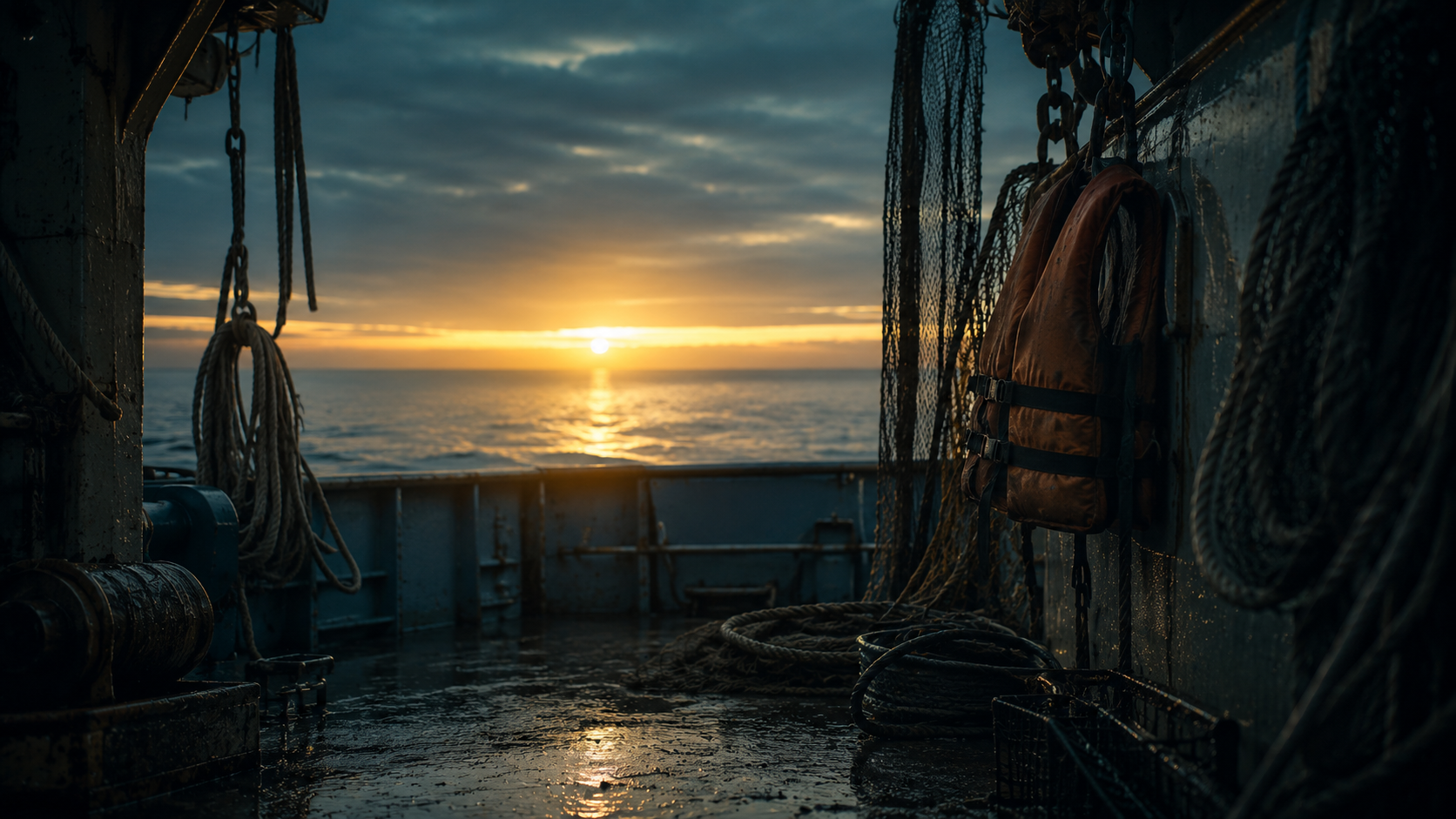
Commercial Fishing Falls Overboard: Your Legal Options After a Man-Overboard Injury or Death
A fisherman goes over the rail in a heartbeat, a slip on a wet deck, a rogue wave, a line that catches a leg, and from that instant survival is measured in minutes. Federal safety researchers have studied these moments in grim detail, and what they found does more than describe a tragedy. It points directly at who is responsible and why, because the same equipment gaps that kill fishermen are often the equipment a seaworthy vessel is required to have.
In short: Commercial fishing falls overboard are the second leading cause of death in the industry, and federal data show that none of the victims in a major study were wearing a life jacket. For an injured fisherman or a grieving family, the legal path usually runs through the Jones Act and the doctrine of unseaworthiness, because a vessel that lacks working flotation, alarms, or recovery gear may be legally unseaworthy.
This article is for general informational purposes only and does not constitute legal advice. Maritime deadlines are strict, so consult a licensed maritime attorney about your situation.
Key Facts at a Glance
- Falls overboard are the second leading cause of death among U.S. commercial fishermen, after vessel disasters (Source: CDC NIOSH).
- From 2000 to 2016, 204 commercial fishermen died from unintentional falls overboard, and none were wearing a personal flotation device (Source: NIOSH MMWR).
- From 2000 to 2019, 878 fishermen died while fishing, about 43 per year, with 30 percent of deaths from falls overboard (Source: CDC NIOSH).
- The 2016 commercial fishing fatality rate was 86 deaths per 100,000 workers, about 23 times the rate for all U.S. workers (Source: NIOSH MMWR).
- Most commercial fishermen are Jones Act seamen, with the right to sue for negligence and unseaworthiness (Source: Cornell LII, 46 U.S.C. § 30104).
- A shipowner’s duty to furnish a seaworthy vessel is absolute and does not depend on negligence (Source: Justia, Mitchell v. Trawler Racer).
- A fisherman’s death more than 3 nautical miles offshore is governed by the Death on the High Seas Act (Source: Cornell LII, 46 U.S.C. § 30302).
Why Falls Overboard Are a Category of Their Own
Among fishing injuries, falls overboard sit in a class by themselves because they are common, frequently fatal, and frequently preventable. Federal surveillance shows they are the second leading killer in the industry and that the equipment which would save lives is too often absent (Source: CDC NIOSH). This guide lays out what the data show, why “no one was wearing a life jacket” is a legal fact and not just a sad one, whether fishermen are covered by the Jones Act, how a missing life jacket or recovery device can make a vessel unseaworthy, the vessel’s duty to rescue, what an injured fisherman or a family can recover, and the deadlines, with worked examples.
Lost a loved one or survived a fall overboard? The vessel’s safety failures may be the heart of your claim.
How Common Are Fatal Falls Overboard in Commercial Fishing?
Far more common than most people realize, and the federal numbers are stark. NIOSH, which has tracked fishing fatalities through its Commercial Fishing Incident Database since the 1990s, has documented both the scale of the problem and the near-total absence of lifesaving equipment among the victims (Source: CDC NIOSH). The table below collects the key findings.
| Finding | Figure | Period / source |
|---|---|---|
| Total commercial fishing deaths | 878 (about 43 per year) | 2000-2019 (NIOSH) |
| Share from falls overboard | 266 deaths (30%) | 2000-2019 (NIOSH) |
| Fall-overboard deaths studied | 204 | 2000-2016 (NIOSH MMWR) |
| Victims wearing a PFD | None (0) | 2000-2016 (NIOSH MMWR) |
| Falls that were not witnessed | 121 (59.3%) | 2000-2016 (NIOSH MMWR) |
| Industry fatality rate | 86 per 100,000 (23x all workers) | 2016 (NIOSH MMWR) |
Why Does It Matter That No Victims Were Wearing a Life Jacket?
Because in maritime law, that fact is not just tragic; it is evidence. NIOSH found that not one of the 204 fishermen who died from falls overboard between 2000 and 2016 was wearing a personal flotation device, and it urged vessel owners to adopt PFDs, man-overboard alarms, recovery devices, and rescue training (Source: NIOSH MMWR). When a fisherman goes overboard from a vessel that provided no wearable flotation, no alarm to signal the fall, and no device to pull a person from the water, those gaps are not background detail. They go to the core legal question of whether the vessel was seaworthy, which the next sections explain. The federal recommendation of what a vessel should carry effectively describes the standard a court may measure the vessel against.
Are Commercial Fishermen Covered by the Jones Act?
Almost always, yes. A commercial fisherman who is a member of a fishing vessel’s crew is a seaman, and the Jones Act gives seamen the right to sue their employer for negligence and to recover for an unseaworthy vessel (Source: Cornell LII, 46 U.S.C. § 30104). Seaman status requires a substantial connection to a vessel in navigation, which crew members of a working fishing boat plainly have under the standard set in Chandris, Inc. v. Latsis (Source: Justia, Chandris v. Latsis). This matters enormously for a fall overboard, because it means the fisherman or the family is not limited to a no-fault benefit; they can pursue full damages where the employer was negligent or the vessel was unseaworthy. A deckhand on a shrimp trawler or a sternman on a lobster boat is the textbook seaman, and the Jones Act is the textbook remedy.
Can a Missing Life Jacket or Recovery Device Make the Vessel Unseaworthy?
This is where the NIOSH data and the law meet, and it is the strongest part of many fall-overboard cases. A vessel is unseaworthy when it or its equipment is not reasonably fit for its intended use, and the Supreme Court held in Mitchell v. Trawler Racer, Inc., a case involving a member of a fishing trawler’s crew, that the shipowner’s duty to furnish a seaworthy vessel is absolute and is not limited by concepts of negligence (Source: Justia, Mitchell v. Trawler Racer). A vessel that fails to provide wearable flotation, a man-overboard alarm, or a means to recover a crew member from the water can be argued to be unfit for the dangerous work of commercial fishing, and because the duty is absolute, the owner cannot defend simply by claiming it did not know. As a worked example: a deckhand is swept off an unlit afterdeck that had no railing, no throwable recovery device aboard, and no PFD issued to the crew; each missing item is a separate basis to argue the vessel was unseaworthy, independent of anyone’s negligence. The federal finding that victims had no PFDs turns a safety statistic into the spine of a liability case.
Missing flotation, alarms, or recovery gear can make a fishing vessel legally unseaworthy.
Does the Vessel Have a Duty to Rescue a Fisherman Who Falls Overboard?
Yes. Maritime law imposes on a vessel a duty to make reasonable efforts to rescue a crew member who goes overboard, and a failure to mount a prompt, competent rescue can itself be a basis for liability. The NIOSH data show why this duty is so consequential: among witnessed falls, rescue attempts were made in most cases, but many victims were never recovered, and the majority of falls were not witnessed at all (Source: NIOSH MMWR). That pattern points to the same equipment gaps, no alarm to signal a fall, no recovery device to bring a person back aboard, that also support an unseaworthiness claim. When a crew cannot find or retrieve a fisherman because the vessel lacked the basic means to do so, the failure of rescue and the unseaworthiness of the vessel are two sides of the same fact.
What Can an Injured Fisherman Recover?
A fisherman who survives a fall overboard can pursue the full suite of maritime remedies. Under the Jones Act and the doctrine of unseaworthiness, a seaman can recover for medical expenses, lost earnings and earning capacity, pain and suffering, and disability, and separately is owed maintenance and cure, a daily living allowance and medical care, until reaching maximum medical improvement regardless of fault (Source: Cornell LII, 46 U.S.C. § 30104). Maintenance and cure is especially important after a near-drowning, because the medical course, including cold-water immersion injury, lung damage, or hypoxic brain injury, can be long and expensive, and the seaman should not have to fund it alone while the larger claim develops. Comparative fault can reduce a recovery but does not bar it, so a fisherman’s own momentary misstep on a wet deck does not end the claim.
What If the Fisherman Died?
The family’s path depends largely on where the death occurred, and the differences are significant. The table below maps the routes.
| Situation | Governing law | What can be recovered |
|---|---|---|
| Fisherman survives the fall | Jones Act + unseaworthiness + maintenance and cure | Full damages plus living/medical support (§ 30104) |
| Dies in state waters (within 3 nm) | Jones Act survival + general maritime / state wrongful death | Broader damages, often including some non-pecuniary losses |
| Dies on the high seas (beyond 3 nm) | DOHSA (plus the Jones Act if a seaman) | Pecuniary losses; DOHSA limits non-pecuniary recovery (§ 30302) |
| Body never recovered | Same routes; death can be legally presumed | A claim still proceeds on the evidence of the fall |
| Caused by another vessel or third party | Third-party negligence claim | Full tort damages from the responsible party |
The 3-nautical-mile line matters because DOHSA generally restricts a high-seas wrongful-death recovery to pecuniary losses, which is one reason the precise location of the fall is established early in these cases (Source: Cornell LII, 46 U.S.C. § 30302).
A Worked Example: An Unwitnessed Fall on a Shrimp Trawler
Picture a Gulf shrimp deckhand who is on watch alone at night and is not at the rail when his crewmates last see him; he is later found missing. The NIOSH data make clear how typical this is: the majority of fatal falls are unwitnessed, and Gulf shrimp operations recorded the highest number of fall-overboard deaths in the federal study (Source: CDC NIOSH). The family’s case is built on what the vessel lacked: no man-overboard alarm meant no one knew he had gone over, no PFD meant he could not stay afloat, and no recovery device meant no realistic chance of retrieval. Each gap supports an unseaworthiness claim under Mitchell, the failure to detect and rescue supports a separate theory, and because the fall happened well offshore, DOHSA frames the recoverable damages (Sources: Mitchell, 362 U.S. 539; 46 U.S.C. § 30302). The statistic that “no one was wearing a life jacket” becomes the first sentence of the family’s case.
How Long Do You Have to File?
The clock is strict. A Jones Act or general maritime claim generally must be filed within three years of the injury or death, and DOHSA claims run on a comparable three-year period (Source: Cornell LII, 46 U.S.C. § 30106). In a fall-overboard case, the evidence that wins, the condition of the deck and rails, what safety and recovery equipment was aboard and whether it worked, the crew’s training, and the timeline of the rescue attempt, degrades quickly: vessels are repaired or sold, gear is replaced, and crews disperse. The practical advice is to preserve that evidence and consult a maritime attorney promptly, well before the three-year deadline, so the vessel’s equipment and rescue response can be documented while the record still exists.
Frequently Asked Questions
How common are fatal falls overboard in commercial fishing?
They are the second leading cause of death in the industry; NIOSH recorded 266 fall-overboard deaths from 2000 to 2019, about 30 percent of all fishing fatalities (Source: CDC NIOSH).
Why does it matter that victims were not wearing life jackets?
NIOSH found none of 204 fall-overboard victims wore a PFD; a vessel that fails to provide flotation and recovery gear may be legally unseaworthy, which is central to a claim (Source: NIOSH MMWR).
Are commercial fishermen covered by the Jones Act?
Yes, crew members of a fishing vessel are generally Jones Act seamen and can sue for negligence and unseaworthiness (Source: Cornell LII, 46 U.S.C. § 30104). To check your situation, get a free case review.
Can a missing life jacket make a vessel unseaworthy?
It can. The duty to furnish a seaworthy vessel is absolute under Mitchell v. Trawler Racer, so a lack of flotation, alarms, or recovery equipment can support an unseaworthiness claim (Source: Justia, Mitchell v. Trawler Racer).
Does the vessel have to try to rescue someone who falls overboard?
Yes. Maritime law requires reasonable rescue efforts, and a failure to detect or retrieve a crew member can be a basis for liability (Source: NIOSH MMWR).
What if the fisherman died far offshore?
A death more than 3 nautical miles offshore is governed by the Death on the High Seas Act, which generally limits recovery to pecuniary losses (Source: Cornell LII, 46 U.S.C. § 30302).
How long do we have to file a claim?
Generally three years from the date of the injury or death for Jones Act, general maritime, and DOHSA claims (Source: Cornell LII, 46 U.S.C. § 30106).
The Bottom Line
A fall overboard is the second deadliest event in commercial fishing, and the federal record of these deaths is also, in effect, a record of what went wrong: victims with no life jackets, falls no one saw, and vessels with no way to bring a person back aboard. For an injured fisherman or a grieving family, those same facts are the foundation of a claim. Most fishermen are Jones Act seamen who can sue for negligence and for an unseaworthy vessel, and the absolute duty of seaworthiness recognized in Mitchell v. Trawler Racer means a vessel that lacked flotation, alarms, or recovery gear can be liable without proof it was careless. Where the death occurred sets the damages, with DOHSA controlling beyond 3 nautical miles, and a three-year clock governs throughout. Document what the vessel did and did not have, and do it before the evidence is gone.
If a fall overboard injured you or took a loved one, the vessel’s safety failures may be the key to your case.
References and Sources
- Jones Act, 46 U.S.C. § 30104: Cornell Legal Information Institute
- Maritime statute of limitations, 46 U.S.C. § 30106: Cornell Legal Information Institute
- Death on the High Seas Act, 46 U.S.C. § 30302: Cornell Legal Information Institute
- Chandris, Inc. v. Latsis, 515 U.S. 347 (1995): Justia U.S. Supreme Court Center
- Mitchell v. Trawler Racer, Inc., 362 U.S. 539 (1960): Justia U.S. Supreme Court Center
- Fatal Falls Overboard in Commercial Fishing, United States, 2000-2016 (MMWR): CDC NIOSH
- Commercial fishing fatality data and regional summaries (2000-2019): CDC NIOSH
- Commercial fishing safety overview: CDC NIOSH
- NIOSH bulletin: fatal falls overboard (causes, regions, equipment): CDC NIOSH
- Maintenance and cure overview: Preston Easley
- Commercial fishing dangers and Jones Act context: Boatlaw
- NIOSH falls-overboard prevention and recovery guidance: CDC NIOSH
Editorial Standards and Review
This article follows a zero-hallucination policy. The fatality statistics are drawn from NIOSH’s Commercial Fishing Incident Database and its peer-reviewed MMWR analysis and are cited to the CDC; the governing law (the Jones Act, DOHSA, and the maritime limitations period) is cited to the U.S. Code; and the seaman-status and unseaworthiness doctrines to the controlling Supreme Court decisions in Chandris v. Latsis and Mitchell v. Trawler Racer. The worked examples are illustrative and not specific cases. This article addresses commercial fishing falls overboard specifically and does not estimate settlement amounts. OffshoreInjuryHelp.com is an informational resource, not a law firm, and does not provide legal representation; it connects injured fishermen and their families with experienced maritime attorneys. Learn more on our Editorial Standards page. Last reviewed: June 1, 2026.