What Is a Vessel Under Maritime Law?
One word can decide whether an injured maritime worker has powerful rights or almost none, and that word is “vessel.” Here is exactly how the term vessel under maritime law is defined and why that definition controls so much of an offshore injury case.
This article is for informational purposes only and does not constitute legal advice. Vessel status is a fact-specific question that can decide an entire case; to understand how it applies to your work, consult a licensed maritime attorney.
Key Facts at a Glance
- The controlling definition of a vessel is in 1 U.S.C. § 3: every description of watercraft or other artificial contrivance used, or capable of being used, as a means of transportation on water (Source: Cornell LII).
- The Supreme Court adopted that statutory definition for maritime law and held a dredge is a vessel in Stewart v. Dutra Construction Co., 543 U.S. 481 (2005) (Source: Justia).
- A structure qualifies only if it is practically capable of maritime transportation, not merely theoretically capable, Stewart, 543 U.S. at 496 (Source: Justia).
- A floating home that cannot practically transport people or things is not a vessel, Lozman v. City of Riviera Beach, 568 U.S. 115 (2013) (Source: Justia).
- Jones Act seaman status requires a substantial connection to a vessel in navigation, Chandris, Inc. v. Latsis, 515 U.S. 347 (1995) (Source: Justia).
- Fixed offshore platforms attached to the seabed are treated as artificial islands, not vessels, Rodrigue v. Aetna Casualty & Surety Co., 395 U.S. 352 (1969) (Source: Justia).
- A craft can lose vessel status if it is permanently moored or withdrawn from navigation for an extended period (Source: Justia).
Hurt offshore and unsure which law protects you? The structure you worked on may be the deciding factor.
We are not a law firm and not attorneys; we connect injured maritime workers and families with experienced maritime attorneys at no cost.
Maritime law gives its strongest protections to people who work on vessels. A Jones Act seaman can sue an employer for negligence, demand a jury trial, and invoke the vessel owner’s near-strict duty of seaworthiness. A worker who is not connected to a vessel usually cannot, and is instead routed into a workers’ compensation system with no pain-and-suffering recovery. Because so much turns on the word, defendants and injured workers fight over vessel status in case after case.
This guide explains the definition completely: the statutory text, the two Supreme Court decisions that bracket it, why the question matters, which offshore structures count and which do not, the edge cases that trip people up, and how the issue is actually litigated. The aim is a single page that answers the vessel question without sending you anywhere else, including a structure-by-structure table no general explainer provides.
What Is the Legal Definition of a Vessel Under Maritime Law?
The legal definition of a vessel under maritime law comes from 1 U.S.C. § 3, which defines the term to include every description of watercraft or other artificial contrivance used, or capable of being used, as a means of transportation on water (Source: Cornell LII). This is the general definitional section of the U.S. Code, and for decades courts disagreed about whether it controlled in injury cases or whether a narrower, purpose-based test applied. The Supreme Court resolved that in 2005, holding that § 3 supplies the controlling definition across maritime statutes, including the Jones Act and the Longshore and Harbor Workers’ Compensation Act. The key phrase is “capable of being used” for transportation, which means the inquiry is about a structure’s practical function on water, not its name, its primary business, or whether it happened to be moving when someone was hurt.
What Did Stewart v. Dutra Decide About Vessel Status?
Stewart v. Dutra Construction Co., 543 U.S. 481 (2005), held that the dredge Super Scoop was a vessel and set the modern test. The Super Scoop was a massive floating dredge with limited self-propulsion that moved only every couple of hours while digging a Boston harbor trench, and a marine engineer was badly hurt aboard it (Source: Cornell LII). A unanimous Court adopted the 1 U.S.C. § 3 definition and rejected two narrower tests: the primary-purpose test, which asked whether the craft’s main job was transportation, and the snapshot test, which asked whether it was moving at the instant of injury. What matters, the Court held, is whether the structure is practically capable of being used to transport people, freight, or cargo over water. The “in navigation” requirement means only that a craft can lose vessel status if it is withdrawn from the water for an extended period, not that it must be underway.
Worked example: A floating dredge sits anchored, working a channel, and moves only a few feet each hour. An injured deckhand’s employer argues the dredge is a work platform, not a vessel, because its job is digging, not transport. Under Stewart that argument fails: the dredge is practically capable of maritime transportation and has not been withdrawn from navigation, so it is a vessel and the deckhand can pursue seaman status.
How Does Lozman v. Riviera Beach Limit the Definition?
Lozman v. City of Riviera Beach, 568 U.S. 115 (2013), drew the outer boundary by holding that a floating home was not a vessel. Lozman’s structure was a house-like box on a bare floating platform that had no steering, no engine, and no capacity to generate or store power, and it had been towed only a handful of times (Source: Justia). The Court rejected an “anything that floats” rule and announced a reasonable-observer test: a structure is a vessel only if a reasonable observer, looking at its physical characteristics and activities, would consider it designed to a practical degree for carrying people or things over water. Because nothing about Lozman’s home other than the fact that it floated suggested a transportation function, it failed the test. Lozman is the counterweight to Stewart: capability must be genuine and practical, judged objectively, not invented from the mere ability to float under tow.
Worked example: A floating casino is towed to a riverbank, connected to shore utilities, and left in place for years with no intention of moving. A cocktail server injured aboard claims seaman status. Under Lozman and Stewart, a reasonable observer would not see the moored casino as designed for transportation, so it is not a vessel and the server has no Jones Act claim.
Why Does Vessel Status Matter So Much?
Vessel status matters because it is the gateway to nearly every powerful maritime remedy. Jones Act seaman status requires a substantial connection, in both duration and nature, to a vessel in navigation under Chandris, Inc. v. Latsis, 515 U.S. 347 (1995), so no vessel means no seaman (Source: Justia). The unseaworthiness doctrine is a duty owed by a vessel owner, so it exists only if there is a vessel; see our explanation of unseaworthiness claims. Maritime jurisdiction and the maintenance and cure obligation likewise track vessel status. Even for longshore workers, the vessel question reappears: a harbor worker covered by the LHWCA can sue a negligent vessel owner under 33 U.S.C. § 905(b), a remedy that exists only against a vessel (Source: Cornell LII).
| What turns on vessel status | If the structure is a vessel | If it is not a vessel | Authority |
|---|---|---|---|
| Jones Act seaman status | Worker may qualify as a seaman | No seaman status; LHWCA or OCSLA route | Chandris, 515 U.S. 347 |
| Negligence remedy | Jones Act negligence vs. employer | No-fault comp benefits only | 46 U.S.C. § 30104 |
| Unseaworthiness | Vessel owner owes a seaworthy vessel | Doctrine does not apply | Unseaworthiness |
| Maintenance and cure | Owed to a seaman injured in service | Not available | Maintenance and cure |
| Longshore worker’s tort claim | 905(b) negligence vs. vessel owner | Comp only, no third-party vessel claim | 33 U.S.C. § 905(b) |
Which Offshore Structures Count as Vessels?
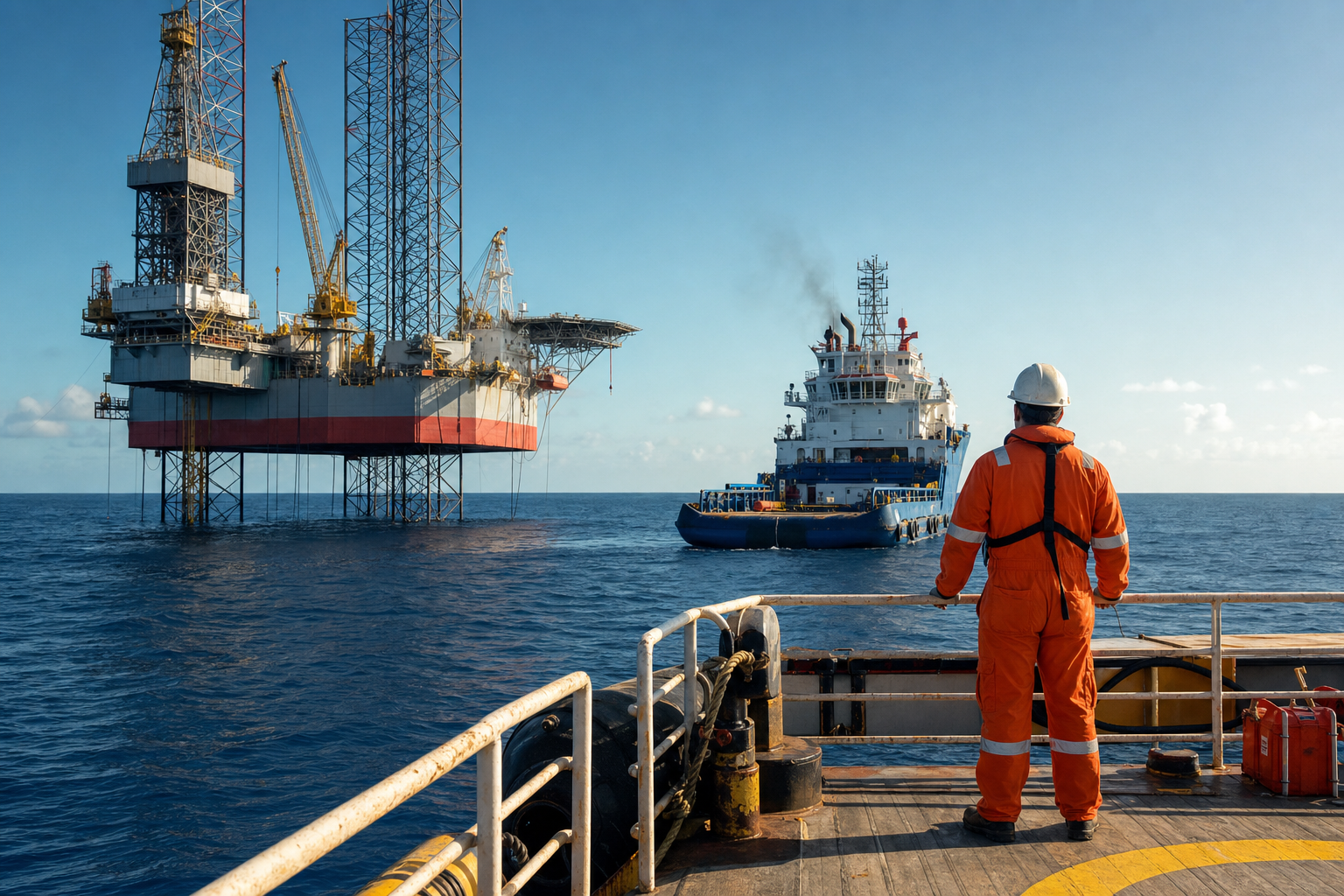
Most mobile offshore craft are vessels, while structures fixed to the seabed are not. Drillships, semi-submersibles, jack-up rigs, and other mobile offshore drilling units are generally vessels because they are designed to be moved and are practically capable of transportation, even when temporarily stationary on a drill site. Supply vessels, crew boats, tugs, and barges in transit are vessels in the ordinary sense. The dividing line is practical transportation capability judged by Stewart and Lozman. The table below maps common offshore structures to their usual classification; the word “usually” matters, because borderline craft turn on their specific facts and the law of the circuit.
| Structure | Usually a vessel? | Why |
|---|---|---|
| Drillship | Yes | Self-propelled ship-shaped drilling unit, built to move |
| Semi-submersible MODU | Yes | Mobile offshore drilling unit, towed or self-propelled between sites |
| Jack-up rig | Yes | Floated to location then jacked up; remains practically capable of transport |
| Supply vessel / OSV, crew boat, tug | Yes | Core transportation function on water |
| Barge under tow | Yes | Carries cargo or equipment over water |
| Dredge (working, not withdrawn) | Yes | Holding of Stewart v. Dutra |
| Fixed platform on the seabed | No | Artificial island under Rodrigue; OCSLA and LHWCA govern |
| Spar or tension-leg platform | Usually no | Moored production structure, generally not transportation |
| Indefinitely moored casino or work barge | No | Withdrawn from navigation; fails Lozman observer test |
The classification of the structure you worked on can decide your entire claim. Have it reviewed.
We are not a law firm and not attorneys; we connect injured maritime workers and families with experienced maritime attorneys at no cost.
Why Are Fixed Platforms Not Vessels?
Fixed platforms are not vessels because they are permanently attached to the seabed and have no capacity to transport anything over water. The Supreme Court treated such platforms as artificial islands in Rodrigue v. Aetna Casualty & Surety Co., 395 U.S. 352 (1969), holding that injuries on them are not governed by general maritime law but by the Outer Continental Shelf Lands Act and adopted state law (Source: Justia). As a result, a worker injured on a fixed platform is usually not a Jones Act seaman and is instead covered through OCSLA and the LHWCA. This is exactly why oil and gas injury cases turn on classification: a worker assigned to a drillship may be a seaman, while a coworker on a neighboring fixed platform is not. We explain that split in our guide to Jones Act or Longshore coverage for platform workers.
Are Jack-Up Rigs and Drillships Vessels?
Yes. Jack-up rigs and drillships are generally vessels, and the workers assigned to them can qualify as seamen. A jack-up rig floats to its location and then lowers legs to the seabed to lift its hull above the waves, but lowering the legs does not make it a fixed structure; it remains practically capable of being moved and is treated as a vessel under the Stewart standard. Drillships are even clearer, since they are ship-shaped, self-propelled, and built to relocate. The temporary fact that a mobile offshore drilling unit is stationary on a drill site does not strip its vessel status, because Stewart rejected the snapshot approach. The practical consequence is significant: a roughneck on a jack-up rig or drillship typically has access to Jones Act negligence, unseaworthiness, and maintenance and cure, while a counterpart on a fixed platform does not.
Can a Structure Stop Being a Vessel?
Yes. A craft that was once a vessel can lose that status if it is taken out of navigation. Stewart explained that a structure may cease to be a vessel when it is withdrawn from the water or permanently moored for an extended period, and lower courts have applied that idea to floating casinos and processing plants secured to shore in a semi-permanent or indefinite manner. The reverse is also true: a craft under construction that is not yet capable of transportation is generally not yet a vessel, and a vessel sent to a scrapyard or laid up indefinitely can shed its status. The question is always present capability and use, judged objectively. This is why a worker’s status can change over time and why the date and circumstances of the injury matter to the analysis.
How Does a Court Decide Whether Something Is a Vessel?
A court works through a practical sequence. It starts with the text of 1 U.S.C. § 3 and asks whether the structure is watercraft or an artificial contrivance used or capable of being used for transportation on water. It then applies the Stewart practicality filter: capability must be real, not theoretical, and a craft does not lose vessel status merely because it is stationary or has a non-transport primary purpose. Next it applies the Lozman reasonable-observer test, asking whether the structure’s physical characteristics and activities show a design, to a practical degree, for carrying people or things over water. Finally it checks the in-navigation status, because a withdrawn or permanently moored craft can fall outside the definition. Some of these questions are decided by the judge and some can go to a jury when the underlying facts are disputed.
How Do Defendants Use Vessel Status as a Defense?
Defendants treat vessel status as a strategic switch and argue it both ways depending on what helps them. To defeat a strong Jones Act claim, an employer will argue the structure is not a vessel, hoping to strip the worker of seaman status and push the case into the no-fault LHWCA or OCSLA framework where there is no recovery for pain and suffering. In a different posture, a vessel owner may argue that a structure is a vessel in order to invoke the Limitation of Liability Act and cap its exposure at the value of the craft. Injured workers counter by documenting the structure’s transportation capability, its movement history, and its design, and by framing the facts against Stewart and Lozman. Because the same facts can support opposite arguments, vessel status is often the most consequential dispute in an offshore case.
Key Decisions on What Counts as a Vessel
| Case | Court and year | Holding |
|---|---|---|
| Cope v. Vallette Dry Dock Co. | U.S. Supreme Court, 1887 | A permanently moored drydock is not a vessel |
| Evansville & Bowling Green Packet Co. v. Chero Cola | U.S. Supreme Court, 1926 | A wharfboat tied to the bank is not a vessel |
| Rodrigue v. Aetna Casualty & Surety Co. | U.S. Supreme Court, 1969 | Fixed offshore platforms are artificial islands, not vessels |
| Chandris, Inc. v. Latsis | U.S. Supreme Court, 1995 | Seaman status requires a substantial connection to a vessel in navigation |
| Stewart v. Dutra Construction Co. | U.S. Supreme Court, 2005 | Adopted 1 U.S.C. § 3; a dredge practically capable of transport is a vessel |
| Lozman v. City of Riviera Beach | U.S. Supreme Court, 2013 | A floating home not practically capable of transport is not a vessel |
Frequently Asked Questions
What is the legal definition of a vessel?
Under 1 U.S.C. § 3, a vessel is every description of watercraft or other artificial contrivance used, or capable of being used, as a means of transportation on water. The Supreme Court adopted this definition for maritime law in Stewart v. Dutra, so the test is whether a structure is practically capable of transporting people or things over water.
Is a jack-up rig a vessel?
Yes, a jack-up rig is generally a vessel. It floats to its location before lowering legs to the seabed, and lowering the legs does not make it a permanent structure. Because it remains practically capable of being moved, it stays a vessel under Stewart, and workers assigned to it can qualify as Jones Act seamen.
Is an oil platform a vessel?
A fixed oil platform attached to the seabed is not a vessel. The Supreme Court in Rodrigue treated such platforms as artificial islands, so workers on them are covered by OCSLA and the LHWCA rather than the Jones Act. Mobile drilling units like drillships and semi-submersibles, by contrast, are usually vessels.
Why does it matter whether something is a vessel?
It matters because vessel status is the gateway to the strongest maritime remedies. Only a connection to a vessel can make a worker a Jones Act seaman, trigger the unseaworthiness doctrine, and support maintenance and cure. Without a vessel, an injured worker is usually limited to no-fault compensation with no recovery for pain and suffering. Find out where you stand if your status is unclear.
What did the Supreme Court decide in Stewart v. Dutra?
In Stewart v. Dutra (2005), the Court held that a working dredge was a vessel and adopted the 1 U.S.C. § 3 definition for maritime law. It rejected tests that asked about a craft’s primary purpose or whether it was moving at the moment of injury, holding that what matters is practical capability for transportation on water.
Can a structure stop being a vessel?
Yes. A craft loses vessel status if it is withdrawn from navigation or permanently moored for an extended period, which is how courts treat indefinitely moored casinos and processing plants. A structure under construction that cannot yet transport anything is generally not yet a vessel. The question is always present, practical capability and use.
Is a barge a vessel under maritime law?
A barge in service and capable of being towed or moved is a vessel, even without its own propulsion, because it is practically capable of transporting cargo or equipment over water. A barge that has been permanently affixed to shore and withdrawn from navigation can lose that status under the reasoning of Stewart and Lozman.
If you were hurt offshore, the structure you worked on may decide your rights. Let an attorney sort it out.
We are not a law firm and not attorneys; we connect injured maritime workers and families with experienced maritime attorneys at no cost.
References and Sources
- Definition of vessel, 1 U.S.C. § 3, Cornell Legal Information Institute
- Stewart v. Dutra Construction Co., 543 U.S. 481 (2005), Justia
- Stewart v. Dutra Construction Co., full opinion, Cornell LII
- Lozman v. City of Riviera Beach, 568 U.S. 115 (2013), Justia
- Chandris, Inc. v. Latsis, 515 U.S. 347 (1995), Justia
- Rodrigue v. Aetna Casualty & Surety Co., 395 U.S. 352 (1969), Justia
- Cope v. Vallette Dry Dock Co., 119 U.S. 625 (1887), Justia
- Evansville & Bowling Green Packet Co. v. Chero Cola Bottling Co., 271 U.S. 19 (1926), Justia
- Jones Act, 46 U.S.C. § 30104, Cornell LII
- LHWCA vessel negligence, 33 U.S.C. § 905(b), Cornell LII
Editorial Standards and Review
This article follows a zero-hallucination policy. Every legal rule, case holding, and statute is traced to a primary or authoritative source linked inline and listed above; Supreme Court holdings are cited to the official reporter and verified against Justia and the Cornell Legal Information Institute, and statutory text is verified against the U.S. Code. We are not a law firm and not attorneys, and nothing here is legal advice. Whether a particular structure is a vessel is a fact-specific question that can decide an entire case, so an injured worker should have the specific facts reviewed by a licensed maritime attorney. Last reviewed June 2026. See our editorial standards.