Offshore Wind Injuries: How Maritime Law Applies to Wind Farm Workers
Offshore wind is one of the fastest-growing industries in U.S. waters, and the law governing injuries to its workers is still taking shape. If you were hurt building, servicing, or transporting components for a wind farm, the single most important question is whether you count as the crew of a vessel or a worker on a fixed structure, because that, more than anything, decides what you can recover.
In short: Which law covers an offshore wind injury depends on where you work. Crew members on vessels that service or install turbines are usually Jones Act seamen, with full tort damages; workers on fixed turbine foundations generally fall under the LHWCA or OCSLA’s no-fault benefits. A 2021 law confirmed the Jones Act reaches offshore wind, but worker-injury coverage still turns on your seaman status.
This article is for general informational purposes only and does not constitute legal advice. Offshore wind injury law is evolving and fact-specific, so consult a licensed maritime attorney about your situation.
Key Facts at a Glance
- Which law covers an offshore wind injury depends on whether the worker is vessel crew or on a fixed structure (Source: WorkBoat).
- Crew on vessels that service or install turbines are usually Jones Act seamen if they spend at least 30% of their time aboard a vessel in navigation (Source: Big Tex Injury Lawyers).
- The Jones Act allows full tort damages, while the LHWCA and OCSLA provide no-fault but capped workers’ compensation benefits (Source: Gilman & Bedigian).
- Section 9503 of the 2021 National Defense Authorization Act amended OCSLA to add “non-mineral energy resources,” confirming federal laws including the Jones Act reach offshore wind (Source: Holland & Knight).
- In January 2021, U.S. Customs and Border Protection issued its first ruling applying the Jones Act to offshore wind vessel activity (Source: gCaptain).
- U.S. offshore wind is projected to add roughly 83,000 jobs by 2030, with specialized Jones Act vessels being built for the work (Source: WorkBoat).
- A Jones Act claim generally must be filed within three years of the injury (Source: Cornell LII, 46 U.S.C. § 30106).
Why Offshore Wind Injury Law Is Still Taking Shape
Offshore wind is a young industry layered on top of maritime laws written for shipping and for oil and gas, so the rules do not always map cleanly onto a turbine field. The work mixes classic seafaring, crews on transfer and installation vessels, with fixed-structure work on foundations rooted to the seabed, and those two worlds are governed by different laws with very different payouts (Source: WorkBoat). This guide explains which laws apply to which workers, what a 2021 federal change did and did not settle, how much classification affects what you recover, and the deadlines that protect a claim.
Hurt on an offshore wind project and unsure which law applies to you?
What Laws Cover an Offshore Wind Worker’s Injury?
Up to four federal maritime laws can apply, and the right one depends on your role and where you were hurt. Seamen who are crew of a vessel fall under the Jones Act; non-seamen working on or near navigable waters fall under the Longshore and Harbor Workers’ Compensation Act (LHWCA); workers on fixed installations on the Outer Continental Shelf may fall under the Outer Continental Shelf Lands Act (OCSLA); and families of workers killed more than three nautical miles offshore may have a claim under the Death on the High Seas Act (Source: Gilman & Bedigian). The table below maps common offshore wind roles to their likely governing law.
| Role / situation | On a vessel? | Likely governing law | What it provides |
|---|---|---|---|
| Crew on a crew transfer vessel | Yes | Jones Act (if a seaman) | Full tort damages (source) |
| Crew on an installation or jack-up vessel | Yes, if a vessel in navigation | Jones Act (if a seaman) | Full tort damages (source) |
| Technician on a fixed turbine foundation | No | OCSLA / LHWCA (evolving) or state law | No-fault benefits (source) |
| Dock, port, or assembly worker on navigable waters | No | LHWCA | No-fault benefits (source) |
| Family of a worker killed beyond 3 nautical miles | Either | DOHSA may apply | Pecuniary wrongful-death damages (§ 30302) |
Are Offshore Wind Vessel Crews Covered by the Jones Act?
Usually, yes, and this is the clearest path to recovery. To be a Jones Act seaman, a worker must contribute to the function of a vessel in navigation and have a substantial connection to it, generally spending at least 30 percent of their work time aboard (Source: Big Tex Injury Lawyers). Offshore wind technicians, engineers, and support staff who work from crew transfer vessels, installation vessels, or other service boats typically meet that test, which makes them seamen entitled to the Jones Act’s full remedies (Source: Southern Injury). For the underlying test, see our Jones Act guide. The classification matters enormously, because Jones Act seamen recover far more than workers covered by no-fault systems.
Did the 2021 Law Change Coverage for Offshore Wind Workers?
Yes, but in a specific way that is widely misunderstood. Section 9503 of the National Defense Authorization Act for Fiscal Year 2021 amended OCSLA to add “non-mineral energy resources” to the federal jurisdiction it extends over installations attached to the seabed, confirming that OCSLA, and the federal laws it carries such as the Jones Act, reach offshore wind projects on the Outer Continental Shelf (Source: Holland & Knight). Shortly after, U.S. Customs and Border Protection issued its first ruling applying the Jones Act to wind-farm vessel activity and treating turbine foundations as “coastwise points” (Source: gCaptain).
What that primarily settled was the cabotage and jurisdiction question, which vessels may lawfully service wind farms, not the separate question of which law governs an injured worker’s claim. For worker injuries, classification still follows the traditional analysis: a crew member who is a seaman recovers under the Jones Act, while a non-seaman on a fixed installation looks to OCSLA and the LHWCA. The 2021 amendment strengthens the argument that OCSLA’s worker-injury coverage reaches fixed wind installations, but because the industry and the case law are still young, how courts apply it to specific injury claims continues to develop (Source: WorkBoat).
What If You Work on a Fixed Turbine Foundation, Not a Vessel?
Then you are generally not a Jones Act seaman, because a foundation permanently attached to the seabed is not a vessel in navigation. Such workers typically look to the LHWCA, and on the Outer Continental Shelf to OCSLA, which extends the LHWCA’s no-fault benefits to covered shelf workers (Source: Gilman & Bedigian). The 2021 OCSLA amendment supports applying that coverage to wind installations, though its application to specific injury claims is still maturing. Where neither the Jones Act nor OCSLA/LHWCA clearly applies, state law may govern instead. Because the boundary between a “vessel” and a “fixed structure” is precisely where these cases are won or lost, fixed-structure workers should not assume they are limited to workers’ comp without a careful look at how and where they actually worked.
Whether you are “vessel crew” or “fixed-structure” can change your recovery by a wide margin.
Why Does the Classification Matter So Much?
Because the two systems pay on entirely different terms. A Jones Act seaman can sue the employer for negligence under a worker-friendly causation standard, bring a separate unseaworthiness claim against the vessel owner, and recover full damages, including lost earnings, future earning capacity, and pain and suffering (Source: Gilman & Bedigian). By contrast, the LHWCA and OCSLA are no-fault systems: the worker does not have to prove negligence, but the benefits are capped wage-replacement and medical payments, with no recovery for pain and suffering from the employer. The practical consequence is that the same injury can be worth dramatically more under the Jones Act than under OCSLA or the LHWCA, which is why the seaman-status question is the heart of most offshore wind injury cases.
How Dangerous Is Offshore Wind Work, and What Injuries Occur?
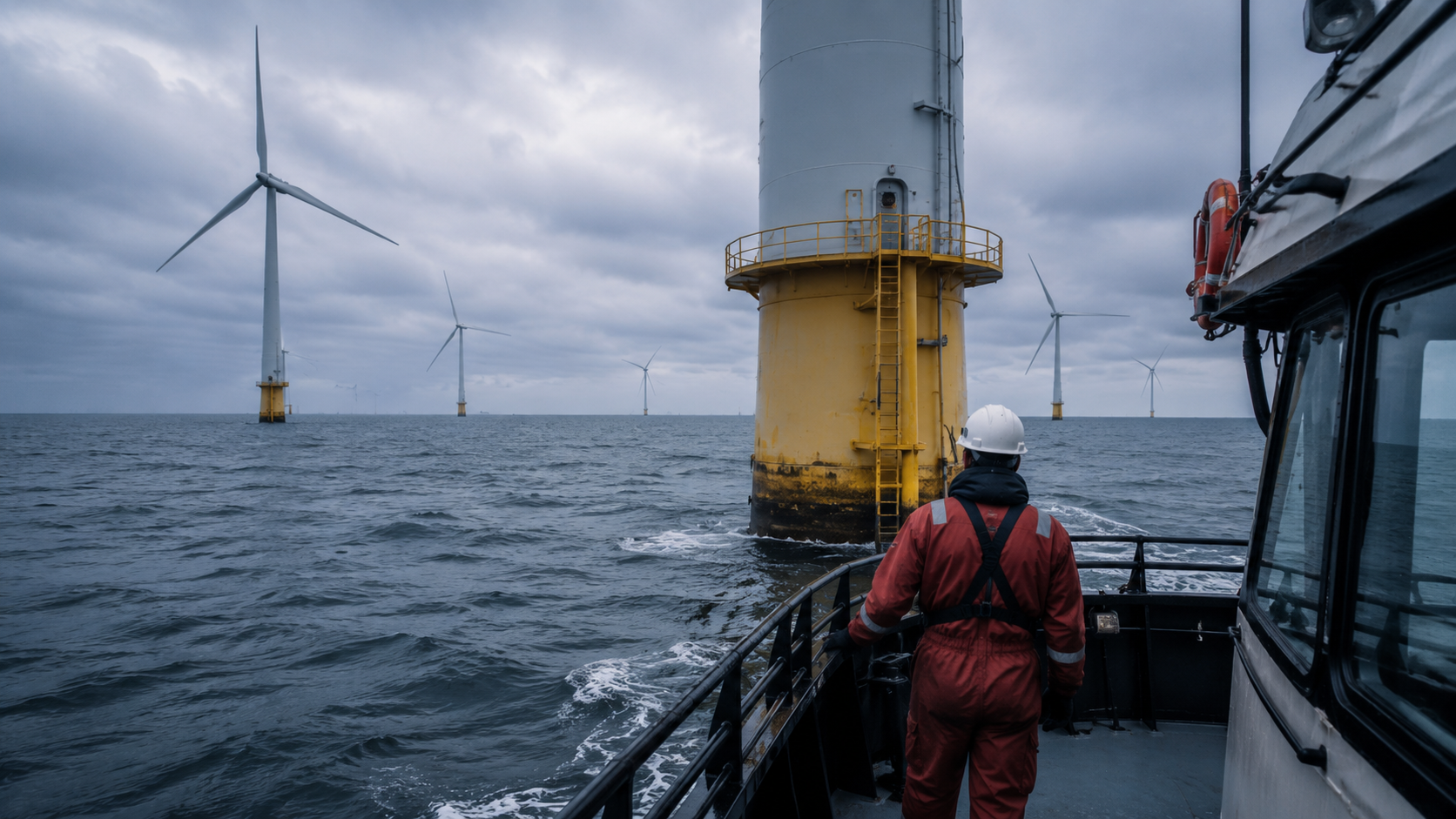
The work combines the hazards of seafaring with those of high-voltage construction at height. Crews transfer between pitching vessels and turbine structures in open water, work aloft on nacelles and blades, and handle heavy components and electrical systems, exposing them to falls, crush injuries, electrocution, and the vessel-based risks common to any maritime job. The industry is expanding quickly, with U.S. offshore wind projected to add roughly 83,000 jobs by 2030 and a fleet of specialized Jones Act support vessels being built to serve it (Source: WorkBoat). As the workforce grows, so will the number of injury claims testing exactly how these maritime laws apply.
How Long Do You Have to File an Offshore Wind Injury Claim?
It depends on which law applies, which is one more reason classification matters. A Jones Act claim generally must be filed within three years of the injury (Source: Cornell LII, 46 U.S.C. § 30106). LHWCA and OCSLA claims run on the Longshore Act’s shorter administrative deadlines, generally notice within 30 days and a claim within one year, while a state-law claim would follow that state’s statute of limitations. Because the applicable deadline is not obvious until the governing law is identified, and because offshore evidence degrades quickly, it is wise to act early rather than risk filing under the wrong framework past the wrong deadline.
Frequently Asked Questions
What law covers an offshore wind worker injury?
It depends on your role: the Jones Act for seamen on service or installation vessels, the LHWCA or OCSLA for workers on fixed structures or docks, and possibly state law where no federal law applies (Source: Gilman & Bedigian).
Are offshore wind technicians Jones Act seamen?
Often yes, if they work from a vessel and spend at least 30% of their time aboard a vessel in navigation (Source: Big Tex Injury Lawyers). If you are unsure of your status, get a free case review.
Did the 2021 law make the Jones Act apply to offshore wind?
It confirmed the Jones Act reaches offshore wind on the Outer Continental Shelf, mainly settling which vessels may service wind farms; worker-injury claims still turn on seaman status (Source: Holland & Knight).
What if I work on a fixed turbine, not a vessel?
You are generally not a seaman; you typically look to the LHWCA or OCSLA’s no-fault benefits, and sometimes state law (Source: Gilman & Bedigian).
Why does seaman status matter so much?
Because Jones Act seamen recover full tort damages including pain and suffering, while LHWCA and OCSLA provide only capped no-fault benefits (Source: WorkBoat).
Can a family sue if a wind worker dies offshore?
Possibly. For deaths more than three nautical miles offshore, the Death on the High Seas Act may apply, providing pecuniary damages to eligible survivors (Source: Cornell LII, 46 U.S.C. § 30302).
How long do I have to file?
Generally three years for a Jones Act claim; LHWCA and OCSLA claims have shorter administrative deadlines (Source: Cornell LII, 46 U.S.C. § 30106).
The Bottom Line
Offshore wind injury law sits at the meeting point of old maritime statutes and a brand-new industry, and the outcome of most cases turns on a single classification: vessel crew or fixed-structure worker. Crews on service and installation vessels are usually Jones Act seamen with access to full tort damages, while workers on fixed foundations generally fall under the no-fault, capped benefits of the LHWCA or OCSLA. The 2021 OCSLA amendment confirmed that federal maritime law, including the Jones Act, reaches offshore wind, but it mainly resolved which vessels may serve the farms, not how an injured worker is classified. Because that classification can change a recovery by an order of magnitude, and because the law is still developing, a careful look at how and where you worked is essential.
Find out which law governs your offshore wind injury and what it could be worth.
References and Sources
- Jones Act, 46 U.S.C. § 30104: Cornell Legal Information Institute
- Maritime statute of limitations, 46 U.S.C. § 30106: Cornell Legal Information Institute
- Outer Continental Shelf Lands Act, 43 U.S.C. § 1333: Cornell Legal Information Institute
- Death on the High Seas Act, 46 U.S.C. § 30302: Cornell Legal Information Institute
- LHWCA coverage, 33 U.S.C. § 903: Cornell Legal Information Institute
- Offshore wind leasing on the Outer Continental Shelf: U.S. Bureau of Ocean Energy Management
- CBP expressly applies the Jones Act to offshore wind (2021 OCSLA amendment): Holland & Knight
- CBP applies the Jones Act to offshore wind projects: gCaptain
- Offshore wind and the landscape of maritime workers’ compensation: WorkBoat
- Compensation for injuries on offshore wind farms: Gilman & Bedigian
- How the Jones Act protects offshore wind workers: Big Tex Injury Lawyers
- Maritime injury law and seaman status: Southern Injury
Editorial Standards and Review
This article follows a zero-hallucination policy. The statutes are cited to the U.S. Code; the 2021 OCSLA amendment and the CBP ruling to a national law firm’s analysis and maritime industry reporting; and the industry data to maritime trade sources. Offshore wind injury law is genuinely evolving, so this article distinguishes what the 2021 amendment settled (federal jurisdiction and Jones Act cabotage over wind) from what still turns on traditional seaman-status analysis (an injured worker’s classification), and notes where the application of OCSLA to wind-worker injury claims is still developing. OffshoreInjuryHelp.com is an informational resource, not a law firm, and does not provide legal representation; it connects injured maritime workers and their families with experienced maritime attorneys. Learn more on our Editorial Standards page. Last reviewed: June 1, 2026.